
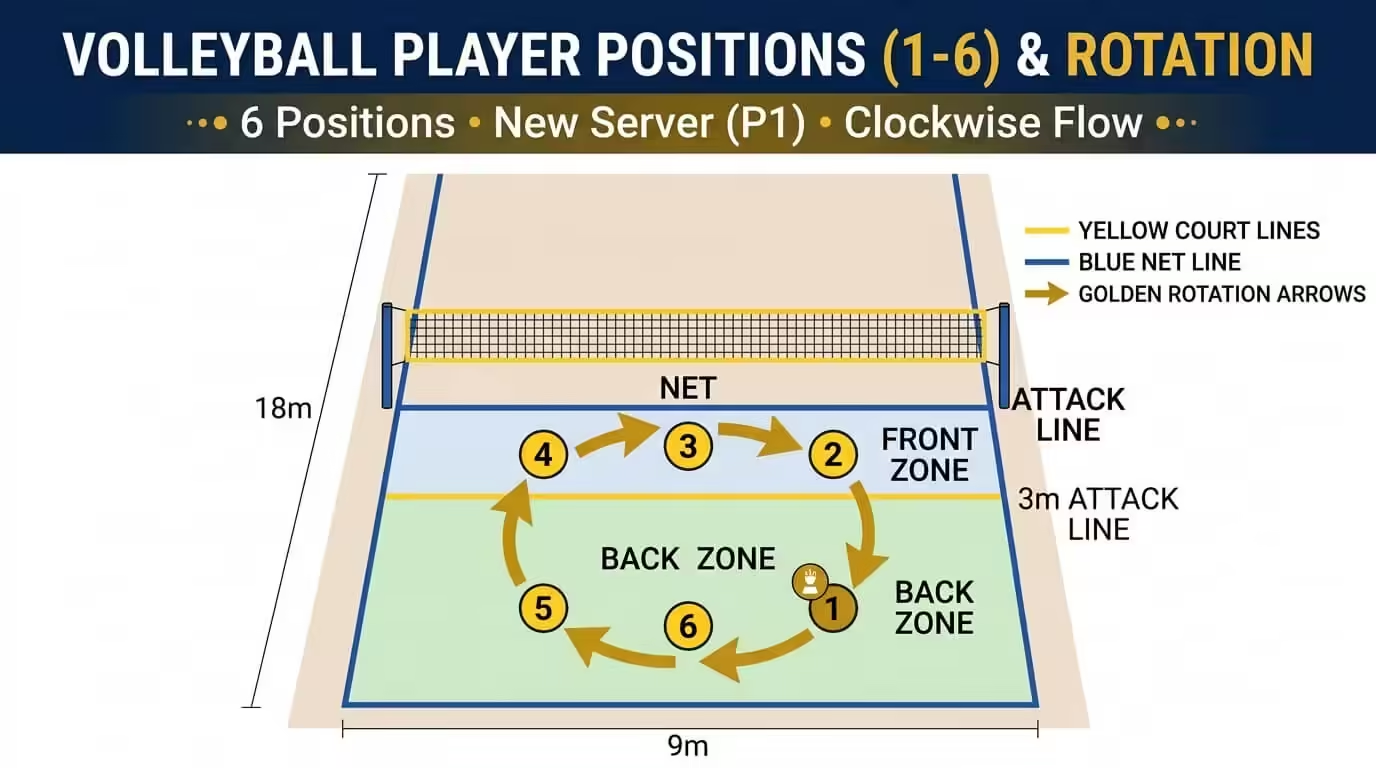
Learning volleyball rotation for beginners can feel overwhelming at first. With players shifting positions, specific court zones, and strict rules about who can hit at the net, it’s easy for new players and coaches to get confused.
Don’t worry—once you understand the why behind the movement, rotation becomes second nature. This comprehensive guide breaks down everything you need to know about volleyball rotation for beginners, complete with court dimensions, position numbers, and practical coaching drills to teach your team with confidence. You Can Learn What Is the Hardest Position in Volleyball? The 4 Brutal Roles Ranked
1. Get the Court Dimensions Right First
Before jumping into player movements, you must understand the court layout. Understanding court setup is the foundation of volleyball rotation for beginners. A standard indoor volleyball court is a rectangle divided into two equal halves:
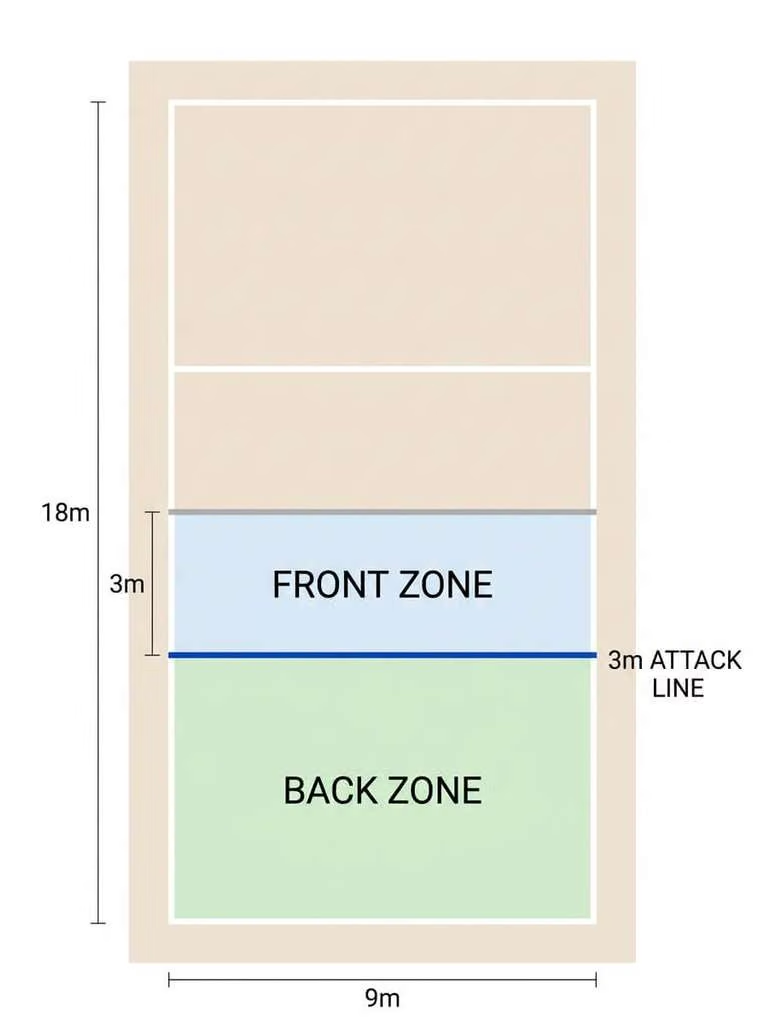
- Total Court Dimensions: 18 meters long by 9 meters wide (59 ft × 29.5 ft).
- Team Playing Area: Each side of the net is a square measuring 9m × 9m.
- Net Heights: 2.43 meters (7’11 5/8″) for men and 2.24 meters (7’4 1/8″) for women.
- The Attack Line (3-Meter Line): Drawn 3 meters (10 feet) parallel to the net on both sides.
Why the 3-Meter Line Matters
The 3-meter line splits your 9m × 9m side into two primary zones:
- Front Zone (3m deep): Where hitters and blockers operate near the net.
- Back Zone (6m deep): Where passers, defenders, and servers operate.
Coaching Tip: When diagramming court setups for volleyball rotation for beginners, draw a top-down view to scale. Remember: your team only occupies one 9m × 9m side at a time.
2. Understanding the 6 Court Positions in Volleyball Rotation
The biggest misconception in volleyball rotation for beginners is confusing rotational court numbers with player job titles (like Setter, Middle Blocker, or Outside Hitter).
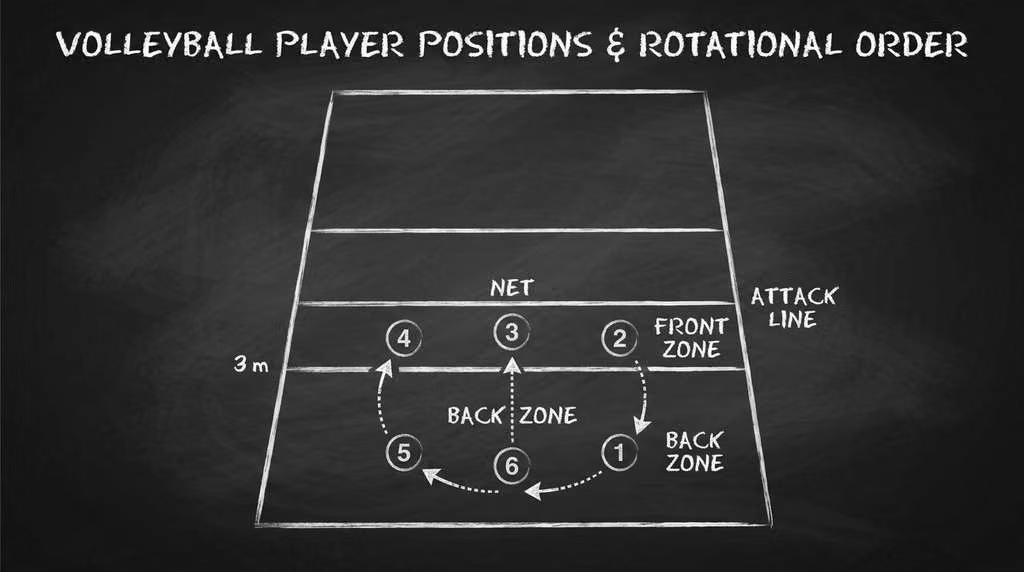
The numbers 1 through 6 represent specific locations on the court—not fixed player roles. As your team rotates, every player will eventually pass through all six spots.
Court Position Breakdown (Facing the Net)
- Position 1 (Right Back – The Server): Located in the back-right corner. This is always where players serve from. Because it’s a back-row position, players here cannot block or attack above the net in front of the 3-meter line.
- Position 2 (Right Front): Located in the front-right corner near the net. Typically home to the Setter or Opposite Hitter in front-row plays.
- Position 3 (Middle Front): Located at the front-center of the net. This spot is designated for the Middle Blocker.
- Position 4 (Left Front): Located in the front-left corner. This is where your primary Outside Hitter operates to execute main attacks.
- Position 5 (Left Back): Located in the back-left corner. Essential for back-row defense, serve receive, and digging hard-driven hits.
- Position 6 (Middle Back): Located in the back-center. Frequently occupied by the Libero to anchor defense and cover deep tips.
Easy Way to Remember Position Numbers
- Front Row: Read left to right along the net as 4 – 3 – 2.
- Back Row: Read left to right along the baseline as 5 – 6 – 1.
- Numerical Direction: Position numbers go counter-clockwise, but players rotate clockwise.
3. How and When to Rotate in Volleyball
When Do You Rotate?
You only rotate when your team wins a rally after the opposing team was serving (known as a “side-out”).
- If your team is serving and wins a point, do not rotate. The same server continues.
- If the opponent is serving and your team wins the point, you earn the serve and must rotate.
How Do You Rotate?
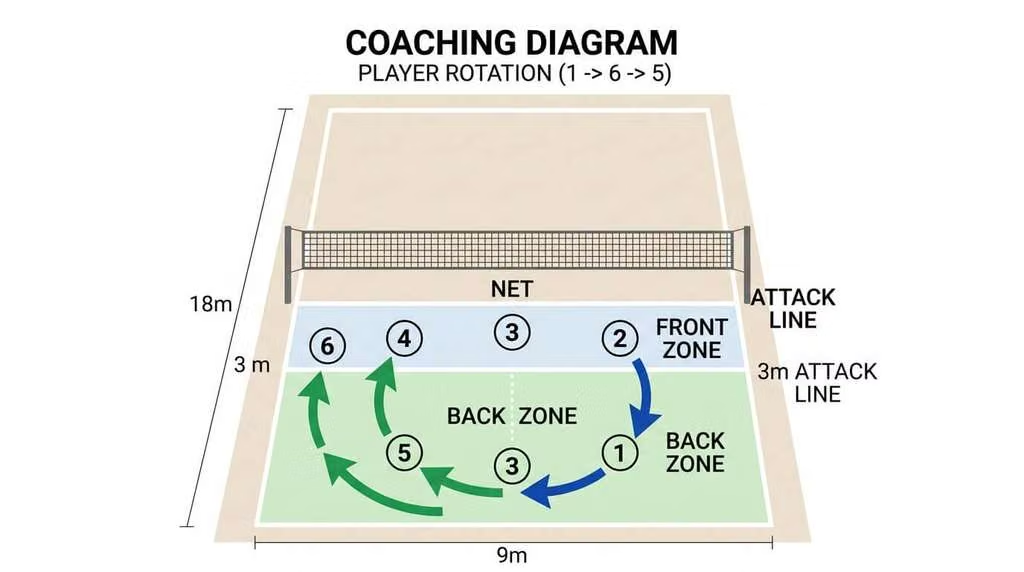
Move one position CLOCKWISE around your side of the court:
$$\text{Position 1} \longrightarrow \text{Position 6} \longrightarrow \text{Position 5} \longrightarrow \text{Position 4} \longrightarrow \text{Position 3} \longrightarrow \text{Position 2} \longrightarrow \text{Position 1}$$
- Position 1 moves to Position 6 (Middle Back).
- Position 6 moves to Position 5 (Left Back).
- Position 5 moves to Position 4 (Left Front).
- Position 4 moves to Position 3 (Middle Front).
- Position 3 moves to Position 2 (Right Front).
- Position 2 moves to Position 1 (Right Back) to become the new server.
4. Why Does Volleyball Use a Rotation System?
While mastering volleyball rotation for beginners seems complex at first, the rule serves three crucial competitive purposes:
- Promotes All-Around Skill Development: Rotation prevents teams from keeping specialized players fixed in one spot (e.g., leaving a tall blocker at the net forever). Everyone must learn to serve, defend, set, and hit.
- Ensures Serving Equality: Every player on the court takes turns serving, preventing teams from relying on a single strong server.
- Creates Strategic Depth: At advanced levels, clockwise rotation forms the foundation for dynamic offensive systems like the 5-1 or 6-2 rotations.
5. Three Critical Volleyball Rotation Rules You Can’t Break
Even in beginner leagues, referees strictly enforce these core rotational faults:
Rule 1: Rotational Order at Serve Contact
At the exact moment the server strikes the ball, players must align with their designated neighbors:
- Front-to-Back: Front-row players must stand in front of their corresponding back-row player (Position 4 in front of 5, 3 in front of 6, 2 in front of 1).
- Left-to-Right: Players cannot cross past their adjacent side-by-side teammates.
- Note: Once the ball is served, players can run anywhere on the court.
Rule 2: Back-Row Attack and Block Restrictions
Back-row players (Positions 1, 5, and 6) cannot block or contact the ball completely above net height if they jump from inside or on the 3-meter line. To hit legally, back-row players must jump from behind the attack line. You Can Also Learn 10 Easy Volleyball Serving Drills for Beginners
Rule 3: Out-of-Order Serving
Serving out of turn results in an automatic loss of the rally and a point awarded to the opposing team.
Quick Tip: Have players call out their rotation spot before each serve (e.g., “I’m in spot 5!”) to prevent out-of-order mistakes when practicing volleyball rotation for beginners.
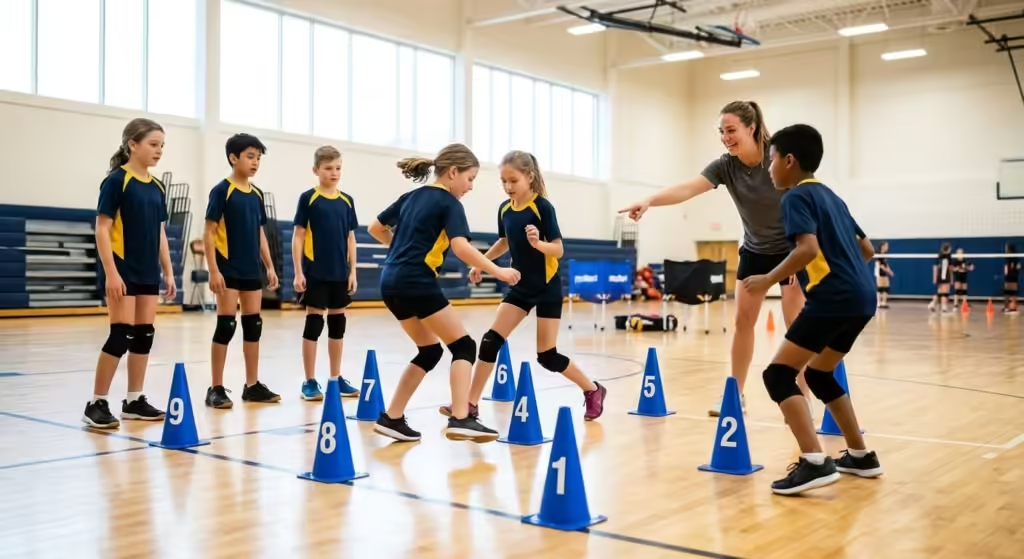
6. How to Teach Volleyball Rotation to Beginners (Step-by-Step Drill)
Avoid putting six beginners on a court without preparation. Follow this progressive teaching drill designed specifically for teaching volleyball rotation for beginners:
- Step 1: Floor Markings: Use floor tape or numbered cones (1–6) on a 9m × 9m court layout. Have players stand directly on their assigned spots.
- Step 2: Walk-Throughs: Blow a whistle and announce “Side-out! We won the serve!” Have players step clockwise to the next cone without a ball. Repeat this 10 times, having players call out their new position.
- Step 3: Mime the Serve: Give the ball to Position 1. After they simulate a serve, let players sprint to their defensive base positions, then immediately return to their correct rotation numbers before the next play.
- Step 4: Serve-Receive Alignment: Practice adjusting formations while maintaining legal overlapping boundaries before serve contact.
7. Common Beginner Rotation Mistakes to Avoid
| Common Mistake | How to Fix It |
| Rotating Counter-Clockwise | Post a whiteboard visual showing clockwise directional arrows near the bench. |
| Confusing Position 1 for Front-Right | Reiterate that Position 1 is always Back-Right where serving takes place behind the baseline. |
| Rotating After Winning Your Own Serve | Remind players to rotate only when winning the ball back from the opposing team’s serve. |
| Stacking Directly Behind Teammates | Stagger court positions during serve-receive so passers keep sight of the server. |
Final Checklist Before Your Next Match
Before stepping onto the court, review this quick summary checklist for volleyball rotation for beginners:
- [ ] Is the court 18m × 9m with a 3-meter attack line?
- [ ] Can you identify court positions 1 through 6 counter-clockwise?
- [ ] Do you know that teams rotate clockwise only on a side-out?
- [ ] Is Position 1 established as the serving spot in the right-back corner?
- [ ] Are back-row players staying behind the 3-meter line to attack?
Mastering volleyball rotation for beginners creates a strong foundation for advanced strategic play. Focus on mastering the basic flow, keep communication clear, and rotating will feel like second nature in no time! You Can Learn More to Join Our Community



One Comment