Learn the basic rules of volleyball fast! Master scoring, player positions, court rotation, and common fouls with this complete beginner’s guide.
What Are the Basic Rules of Volleyball? A Complete Beginner’s Guide
Whether you are stepping onto the court for your first recreational match or trying to follow an exciting professional game, understanding the basic rules of volleyball is essential. Volleyball is a fast-paced, dynamic team sport, but its core objectives and rules are straightforward once you break them down.
In this beginner-friendly guide, you’ll learn how volleyball is played, how scoring works, key court positions, basic rotation rules, and common fouls to avoid.
🏐 The Main Objective of Volleyball
The main goal in volleyball is to hit the ball over the net so that it lands inside the opponent’s court boundaries, while simultaneously preventing the opponent from doing the same on your side.
Each team is allowed up to three consecutive touches to return the ball over the net.
📋 The Top 10 Fundamental Rules of Volleyball
If you only remember ten things before playing your first match, make sure it’s these foundational rules:
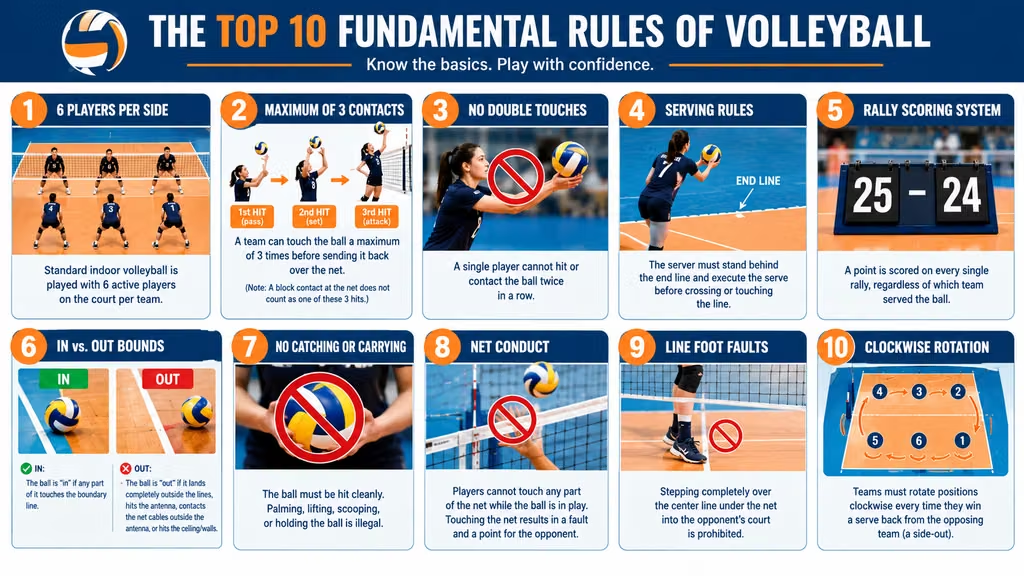
- 6 Players Per Side: Standard indoor volleyball is played with 6 active players on the court per team.
- Maximum of 3 Contacts: A team can touch the ball a maximum of 3 times before sending it back over the net. (Note: A block contact at the net does not count as one of these 3 hits.)
- No Double Touches: A single player cannot hit or contact the ball twice in a row.
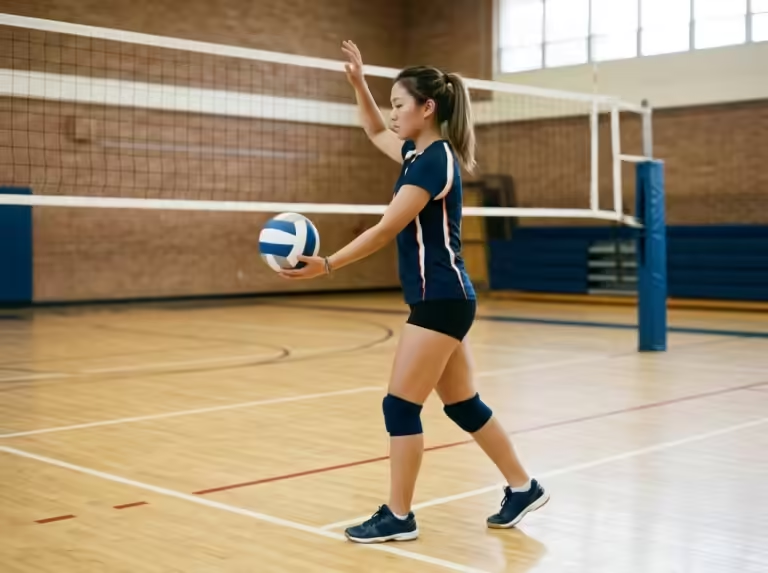
- Serving Rules: The server must stand behind the end line and execute the serve before crossing or touching the line.
- Rally Scoring System: A point is scored on every single rally, regardless of which team served the ball.
- In vs. Out Bounds:
- IN: The ball is “in” if any part of it touches the boundary line.
- OUT: The ball is “out” if it lands completely outside the lines, hits the antenna, contacts the net cables outside the antenna, or hits the ceiling/walls.
- No Catching or Carrying: The ball must be hit cleanly. Palming, lifting, scooping, or holding the ball is illegal.
- Net Conduct: Players cannot touch any part of the net while the ball is in play. Touching the net results in a fault and a point for the opponent.
- Line Foot Faults: Stepping completely over the center line under the net into the opponent’s court is prohibited.
- Clockwise Rotation: Teams must rotate positions clockwise every time they win a serve back from the opposing team (a side-out).
📊 Basic Rules of Volleyball Scoring: How Matches Are Won?
Modern indoor volleyball uses the Rally Scoring System.
- Points needed to win a set: A team wins a set by reaching 25 points first, with at least a 2-point lead (e.g., 25–23 or 27–25).
- Winning the match: Matches are typically played as best-of-5 sets. If a match goes to a 5th set (deciding set), it is played to 15 points (must still win by 2 points).
🔄 Basic Rules of Volleyball Rotation and Court Positioning
Understanding how players rotate can be one of the most confusing parts of volleyball for beginners. Here is a simple breakdown:
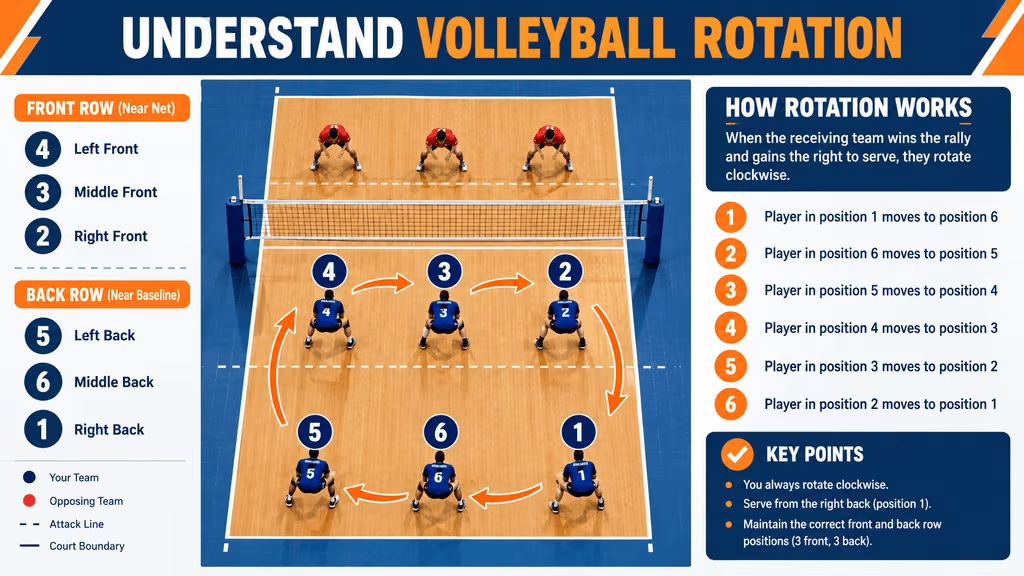
- Positions: The court is divided into six positions—three front-row players (near the net) and three back-row players.
- When to rotate: You only rotate when your team wins a point on the opponent’s serve (this is called a side-out). You do not rotate if your team just scored while serving.
- Direction: Everyone moves one position clockwise. The player in Position 2 (front right) rotates to Position 1 (back right) to become the new server.
👥 Player Positions Under Basic Volleyball Rules?
Every player on the court has a specialized role designed to balance offense and defense:
- Setter (S): The “playmaker” or quarterback of the team. They handle the second contact and set up hitters to attack.
- Outside Hitter (OH): The primary left-side attacker who carries a heavy load on offense and defense.
- Opposite Hitter (OPP): Attacks from the right side and provides strong blocking against the opponent’s outside hitter.
- Middle Blocker (MB): Positioned in the center, responsible for quick attacks and stopping enemy hits at the net.
- Libero (L): A defensive specialist who wears a different colored jersey. They play only in the back row, cannot serve or attack above net height, and can substitute freely.
- Defensive Specialist (DS): A back-row substitute brought in specifically to pass and defend.
🚫 Common Volleyball Violations & Fouls to Avoid
To avoid giving up easy points, watch out for these frequent mistakes:
- Stepping on the line when serving: Your foot cannot touch or cross the end line before contacting the ball.
- Net Touch: Accidentally bumping into the net during an attack or block.
- Illegal Back-Row Attack: A back-row player jumping on or in front of the 10-foot (3-meter) attack line to hit a ball above net height.
- Lift/Carry: Catching, holding, or guiding the ball instead of rebounding it cleanly.
👟 What Equipment Do You Need to Play?
One of the best things about volleyball is its low barrier to entry. All you need to start is:
- Volleyball: Standard indoor ball (or a softer composite leather ball for beginners).
- Court and Net: A standard indoor volleyball court measures 18 m × 9 m. Choosing a durable Professional Heavy Duty Volleyball Net Set for Backyard Outdoor can help beginners practice serving, passing, setting, and spiking while developing their skills. Before purchasing, check the net’s length, height adjustability, and compatibility with your playing space.
- Proper Footwear: Non-marking indoor court shoes with good lateral support.
- Kneepads: Volleyball kneepads are optional but recommended for protecting your knees during dives, floor passes, and defensive drills. Choosing Best volleyball knee pads for beginners with comfortable cushioning, a secure fit, and flexible material can help you practice more comfortably and confidently.
❓ Frequently Asked Questions (FAQ)
Can you use your feet in volleyball?
Yes! Under official FIVB and USA Volleyball rules, you can use any part of your body to keep the ball alive—including your feet, legs, and chest—as long as the contact is clean and continuous.
How long does a volleyball match last?
An average 3-out-of-5 set volleyball match typically lasts 60 to 90 minutes, depending on how competitive the sets are.
What happens if the ball hits the net on a serve?
If a served ball hits the net but still travels over into the opponent’s court, it is still in play.
💡 Summary: Ready to Hit the Court?
Mastering the basic rules of volleyball comes down to three key habits: communicate with your team, limit your hits to three per side, and maintain proper rotation order. Now that you know the rules, grab a ball, head to a local gym or park, and start practicing your serve!