

Learn volleyball positions explained in this beginner’s guide. Discover all six player roles, court positions, rotation rules, and essential skills.
Understanding volleyball positions is one of the first steps toward becoming a confident volleyball player. If you are new to the sport, you might wonder what each player does, where they should stand, and how teams work together during a match.
In volleyball, every player has a specific role on the court. Some players focus on attacking and scoring points, while others specialize in setting, passing, blocking, and defending. Learning these responsibilities makes it easier to understand the game and improve your overall performance.
This volleyball positions explained guide covers all six court positions, including outside hitter, opposite hitter, middle blocker, setter, libero, and defensive specialist. You will also learn about front-row and back-row positions, player rotations, and how each role contributes to the team’s success.
Whether you are joining your first volleyball team or simply learning the basics, this beginner-friendly guide will help you understand where to play and what to do during a match.
Volleyball Positions Explained: How Many Positions Are There?
A standard indoor volleyball team has six players on the court at a time. Each player occupies one of six rotational positions, but teams generally use specialized playing roles.
The six main volleyball positions are:
- Setter
- Outside Hitter
- Opposite Hitter
- Middle Blocker
- Libero
- Defensive Specialist
Each position has different responsibilities. For example, setters organize attacks, hitters score points, middle blockers defend against attacks at the net, and liberos specialize in back-row defense.
Although players have specialized roles, everyone must understand the basic skills of passing, serving, attacking, and defending.
Understanding the Six Volleyball Court Positions

Let’s look at each volleyball position and understand its responsibilities.
1. Setter – The Playmaker of the Team
The setter is often considered the playmaker because they organize the team’s offensive attacks.

After a teammate receives the opponent’s serve or attack, the setter usually takes the second contact and delivers the ball to a hitter. A good set gives the attacker a better opportunity to hit the ball over the net and score.
Main responsibilities of a setter:
- Deliver accurate sets to attackers.
- Communicate with teammates before and during rallies.
- Choose the best attacking option.
- Set quick attacks for middle hitters.
- Help organize offensive strategies.
- Defend and block when positioned in the front row.
Important skills for setters:
- Hand positioning and ball control.
- Quick decision-making.
- Communication.
- Footwork and body balance.
- Consistent overhead setting.
Beginner tip: Practice setting against a wall to improve your hand positioning, accuracy, and ball control. Start with short, controlled repetitions before increasing the difficulty.
2. Outside Hitter – The All-Around Attacker
The outside hitter, also called the left-side hitter, is one of the most versatile players on a volleyball team.
Outside hitters usually attack from the left side of the net. However, their responsibilities go beyond hitting. They also help with serve reception, defense, and blocking.
Main responsibilities of an outside hitter:
- Attack from the left side of the court.
- Receive serves from the opposing team.
- Participate in defensive plays.
- Block opposing outside hitters.
- Communicate with teammates.
- Support the team during difficult rallies.
Important skills for outside hitters:
- Powerful and accurate hitting.
- Passing and serve reception.
- Jumping ability.
- Blocking technique.
- Defensive positioning.
Beginner tip: Work on your passing and attacking skills together. Outside hitters need to be comfortable handling different types of plays, not just hitting the ball.
3. Opposite Hitter – The Right-Side Attacker
The opposite hitter, also known as the right-side hitter, usually plays on the opposite side of the setter in the team’s rotation.
This position focuses on attacking from the right side of the court. Opposite hitters also play an important role in blocking opposing outside hitters.
Main responsibilities of an opposite hitter:
- Attack from the right side of the net.
- Block opposing outside hitters.
- Help defend against attacks.
- Support offensive plays.
- Attack high balls when the team is under pressure.
Important skills for opposite hitters:
- Strong attacking technique.
- Effective blocking.
- Good jumping ability.
- Court awareness.
- Consistent defensive skills.
Beginner tip: Practice hitting from both the front and back rows. Learning to attack from different court positions makes you a more flexible player.
4. Middle Blocker – The First Line of Defense
The middle blocker plays near the center of the net and focuses on stopping the opposing team’s attacks.

This position is especially important during blocking situations. Middle blockers must react quickly and move along the net to defend against attacks from different directions.
They also contribute to offense by performing quick attacks, often immediately after the setter contacts the ball.
Main responsibilities of a middle blocker:
- Block attacks from opposing hitters.
- Perform quick attacks near the setter.
- Read the opponent’s offensive patterns.
- Move quickly along the net.
- Communicate blocking assignments.
- Help defend against opposing attacks.
Important skills for middle blockers:
- Vertical jumping ability.
- Blocking technique.
- Quick lateral movement.
- Timing and coordination.
- Reading the opposing setter.
Beginner tip: Practice your blocking footwork and timing. Instead of simply jumping as high as possible, focus on moving into the correct position and placing your hands over the net.
5. Libero – The Defensive Specialist
The libero is a specialized defensive player who wears a different-colored jersey from the rest of the team.

The main responsibility of a libero is to improve the team’s defense by receiving serves and digging powerful attacks.
Liberos usually play in the back row and are allowed to replace back-row players without counting toward the team’s regular substitution limit.
Main responsibilities of a libero:
- Receive serves from opponents.
- Dig powerful attacks.
- Keep the ball in play.
- Communicate defensive coverage.
- Support teammates during defensive plays.
- Help organize serve-receive formations.
Important skills for liberos:
- Excellent passing technique.
- Fast reaction time.
- Strong court awareness.
- Low defensive positioning.
- Accurate ball control.
Beginner tip: Practice your forearm passing and defensive movements. A libero does not need to hit the ball powerfully; consistent control and accurate passing are much more important.
6. Defensive Specialist – The Back-Row Defender
A defensive specialist is a player who focuses on back-row defense and serve reception.
Unlike the libero, a defensive specialist follows the regular substitution rules and does not wear a different-colored jersey as a requirement of the position.
Coaches often use defensive specialists to strengthen serve reception or improve defensive performance in specific rotations.
Main responsibilities of a defensive specialist:
- Receive difficult serves.
- Dig opposing attacks.
- Cover teammates during offensive plays.
- Improve defensive positioning.
- Communicate with other back-row players.
Important skills for defensive specialists:
- Forearm passing.
- Quick reactions.
- Defensive footwork.
- Court awareness.
- Communication.
Beginner tip: Practice moving quickly in different directions while maintaining a balanced defensive position. Good footwork helps you reach more balls and make controlled passes.
Understanding Volleyball Court Positions: 1 to 6
Besides the six specialized playing roles, volleyball has six numbered rotational positions.
Understanding these positions is important because players must rotate when their team wins the right to serve after receiving the opponent’s serve.
Here is how the six court positions are arranged:
Front-Row Positions
- Position 4: Left Front
- Position 3: Middle Front
- Position 2: Right Front
Back-Row Positions
- Position 5: Left Back
- Position 6: Middle Back
- Position 1: Right Back (Serving Position)
The positions are numbered clockwise around the court.
Important: These numbers describe rotational locations, not permanent player roles. For example, a setter may rotate through several numbered positions while still performing the setter’s responsibilities.
Volleyball Rotation Explained for Beginners
Rotation is an essential part of volleyball. Players must rotate clockwise when their team wins a rally after the opponent was serving.
For example, a player moving from position 2 rotates to position 1, while the player in position 1 moves to position 6.
The rotation continues through all six positions.

How Volleyball Rotation Works
- Your team receives the opponent’s serve.
- Your team wins the rally.
- Your team gains the right to serve.
- All six players rotate one position clockwise.
- The player moving into position 1 serves the ball.
Players must maintain the correct rotational order at the moment the serve is contacted. After the serve, players can move into their specialized playing positions according to the team’s strategy and applicable rules.
Beginner tip: Learn the six numbered court positions first. Understanding the rotation becomes much easier once you know where each player starts.
Front Row vs. Back Row: What’s the Difference?
Volleyball players are divided into front-row and back-row players depending on their rotational positions.
These two areas have different responsibilities and playing restrictions.
Front-Row Players
Front-row players occupy positions 2, 3, and 4.
Their main responsibilities include:
- Attacking the ball near the net.
- Blocking opposing attacks.
- Performing quick offensive plays.
- Covering teammates during attacks.
Front-row players can participate in blocking and complete attacks from the front zone.
Back-Row Players
Back-row players occupy positions 1, 5, and 6.
Their main responsibilities include:
- Receiving serves.
- Digging attacks.
- Supporting defensive coverage.
- Preparing offensive transitions.
Back-row players can attack, but they must follow specific restrictions. For example, a back-row player cannot complete an attack hit from the front zone when the ball is entirely above the top of the net.
Back-row players also cannot participate in a completed block.
Volleyball Positions Comparison Chart
Here is a quick comparison of all six specialized volleyball positions.
| Position | Main Role | Primary Skill |
|---|---|---|
| Setter | Organizes attacks | Setting |
| Outside Hitter | Attacks and receives serves | Hitting and passing |
| Opposite Hitter | Right-side attacking and blocking | Hitting and blocking |
| Middle Blocker | Blocks and performs quick attacks | Blocking |
| Libero | Back-row defense | Passing and digging |
| Defensive Specialist | Serve reception and defense | Defensive passing |
Which Volleyball Position Is Best for Beginners?
There is no single best volleyball position for every beginner. The right position depends on your interests, abilities, comfort level, and the needs of your team.
Here are some general suggestions:
- Setter: A good option if you enjoy controlling the ball, making decisions, and helping teammates attack.
- Outside Hitter: Suitable if you want to develop multiple skills, including passing, attacking, and defense.
- Opposite Hitter: Worth exploring if you enjoy attacking and blocking from the right side.
- Middle Blocker: A good choice if you enjoy blocking, quick attacks, and playing near the net.
- Libero: Suitable if you enjoy defense, passing, and keeping the ball in play.
- Defensive Specialist: A good option if you prefer serve reception and defensive responsibilities.
If you are completely new to volleyball, do not rush to specialize in one position.
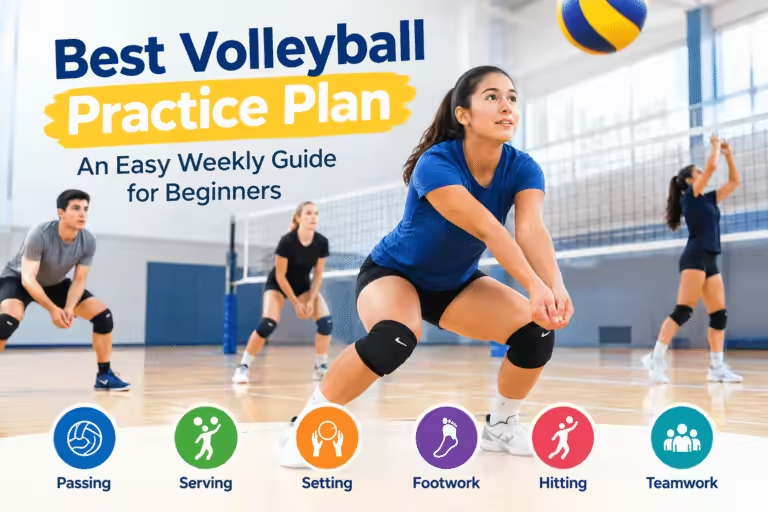
Start by learning the fundamentals of serving, passing, setting, attacking, and defensive movement. As you gain experience, you can discover which position suits your playing style.
Essential Skills Every Volleyball Player Should Learn
Regardless of your position, some volleyball fundamentals are important for every player.
1. Serving
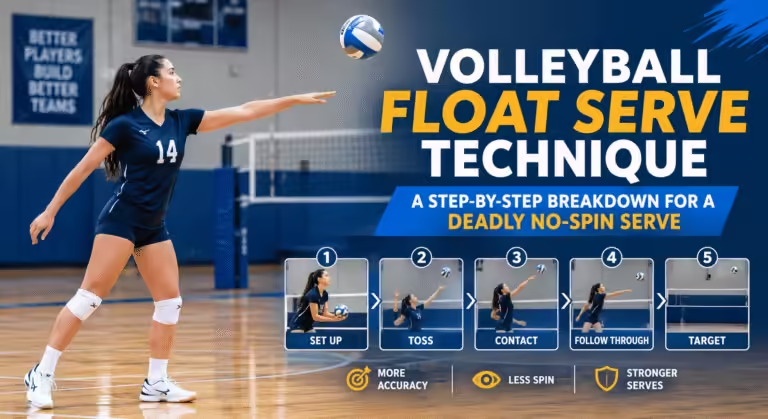
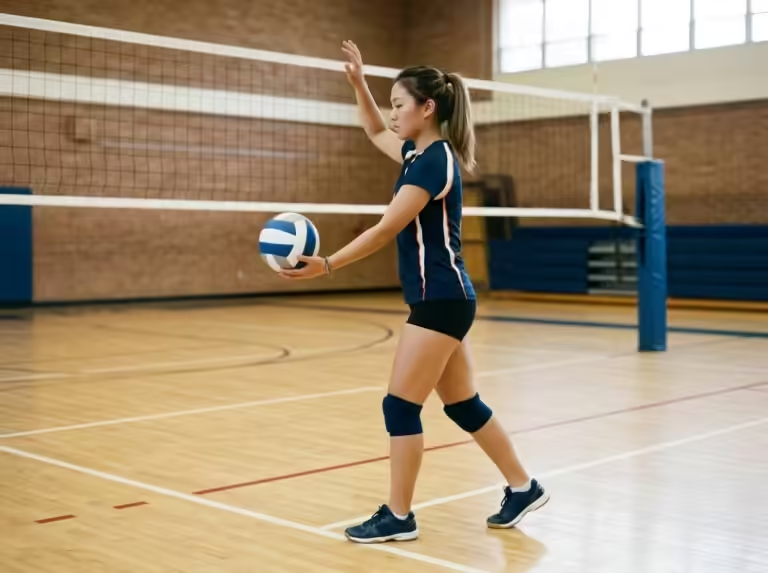
Serving starts every rally. Learn both the underhand and overhand serve before moving on to more advanced serving techniques.
2. Passing
Passing helps your team control the opponent’s serve and prepare an attack. Focus on keeping your platform stable and directing the ball toward the setter. Learn more about how to improve your volleyball passing skills
3. Setting
Setting is usually the second contact in a team’s three-contact sequence. Practice accurate hand positioning and controlled overhead movements. Want to improve your setting technique? Read our guide on how to set a volleyball correctly
4. Attacking
Attacking allows players to send the ball over the net with the intention of scoring. Start with approach footwork and controlled hitting before developing more powerful attacks.
5. Blocking
Blocking helps stop or slow down the opponent’s attack. Learn proper hand positioning, jumping timing, and footwork.
6. Defense
Defensive skills help players keep the ball from touching the floor. Practice your ready position, movement, reaction time, and digging technique.
Common Mistakes Beginners Make When Learning Volleyball Positions
Understanding volleyball positions takes time. Beginners often make a few common mistakes when learning the game.
1. Confusing court positions with player roles
Remember that positions 1–6 describe rotational locations, while setter, libero, and hitter describe specialized roles.
2. Forgetting to rotate
Players must rotate clockwise when their team wins the right to serve from the receiving team.
3. Staying in one place
Volleyball requires constant communication and movement. Players should adjust their positioning depending on the ball and the situation.
4. Ignoring communication
Calling the ball helps prevent confusion and reduces the chance of teammates colliding.
5. Focusing only on one skill
Even specialized players need basic passing, serving, setting, and defensive skills.
6. Not understanding front-row and back-row rules
Players must understand the restrictions that apply to their rotational position. You can follow FIVB – International Volleyball Federation – Official international volleyball organization.
Frequently Asked Questions About Volleyball Positions
How many positions are there in volleyball?
A standard indoor volleyball team has six players on the court. The six specialized roles commonly discussed are setter, outside hitter, opposite hitter, middle blocker, libero, and defensive specialist.
What is the most important position in volleyball?
Every position is important because volleyball requires teamwork. The setter organizes attacks, hitters score points, middle blockers defend the net, and defensive players help keep the ball in play.
What is the easiest volleyball position for beginners?
There is no universally easiest position. Some beginners enjoy playing libero because they focus on passing and defense, while others prefer attacking positions. Your best starting position depends on your strengths and interests.
Can a libero serve in volleyball?
Yes. Under standard indoor volleyball rules, a libero may serve in one rotational position in a set, subject to the applicable competition rules.
Can a setter attack the ball?
Yes. A setter can attack when positioned in the front row and can also attack from the back row if the player follows the back-row attack restrictions.
What are positions 1, 2, 3, 4, 5, and 6 in volleyball?
Position 1 is right back, position 2 is right front, position 3 is middle front, position 4 is left front, position 5 is left back, and position 6 is middle back.
Do volleyball players change positions during a game?
Yes. Players rotate clockwise when their team wins the right to serve after receiving the opponent’s serve. Teams may also use specialized formations and substitutions while following official rotation rules.
Final Thoughts: Learn Volleyball Positions and Improve Your Game
Understanding volleyball positions is an important step toward becoming a better player. Each position has a unique responsibility, but all players must work together to keep the ball in play and score points.
Start by learning the six numbered court positions, understanding rotation, and practicing the basic skills required for volleyball. Once you become comfortable with these fundamentals, you can explore specialized roles such as setter, outside hitter, middle blocker, opposite hitter, and libero.
Remember, becoming a good volleyball player takes patience, consistent practice, and teamwork.
Keep learning, stay active, and enjoy every opportunity to improve your volleyball skills!


One Comment