
Starting high school volleyball can be exciting, especially if you have never played on an organized team before. Whether you want to make your school team, improve your volleyball skills, or simply understand how the game works, learning the basics is the perfect place to start.
High school volleyball teaches more than just serving, passing, setting, and hitting. It also helps players develop teamwork, communication, discipline, confidence, and physical fitness.
This High School Volleyball: Complete Beginner’s Guide explains everything new players need to know, including volleyball rules, player positions, equipment, tryouts, essential skills, practice drills, and tips for preparing for your first season.
At BeginnerVolleyball.com, our goal is to make learning volleyball easier with practical training tips, simple explanations, and beginner-friendly drills.
Let’s get started!
What Is High School Volleyball?
High school volleyball is an organized team sport played between two teams, usually with six players on the court for each team. The objective is to send the ball over the net and make it land inside the opponent’s court while preventing the other team from doing the same.
High school volleyball is commonly played during the school year, with seasons and competition schedules varying by school, state, and region.
Players typically participate in:
- Team practices and conditioning sessions.
- Skill-development drills.
- Friendly matches and scrimmages.
- School competitions and tournaments.
- League and regional championships.
High school volleyball is suitable for students with different experience levels. Some players join with years of club experience, while others learn the sport for the first time.
You do not have to be an expert to begin. A willingness to practice, listen to coaches, and improve consistently is a great starting point.
High School Volleyball Rules Every Beginner Should Know
Understanding the rules helps you play confidently and avoid common mistakes.
Although rules can differ between school associations and competition formats, the following are fundamental volleyball rules used in traditional indoor high school volleyball.
1. Each Team Has Six Players
Each team has six players on the court at a time:
- Three front-row players.
- Three back-row players.

Players rotate positions when their team wins the right to serve after receiving the opponent’s serve.
2. A Team Gets Three Hits
A team is generally allowed up to three contacts to return the ball over the net.
The common sequence is:
- Pass: Receive the serve or opponent’s attack.
- Set: Prepare the ball for an attacker.
- Hit: Send the ball over the net.
A block contact does not count as one of the team’s three hits under standard indoor volleyball rules.
3. Matches Use Rally Scoring
In rally scoring, a point is awarded after every rally, regardless of which team served.
Most traditional high school matches use a best-of-five format:
- The first four sets are generally played to 25 points.
- A deciding fifth set is generally played to 15 points.
- A team must win a set by at least two points.
The exact scoring requirements should be checked against your school’s governing association and competition rules.
4. Players Rotate Clockwise
When the receiving team wins a rally and gains the right to serve, its players rotate one position clockwise.

For example:
- Position 2 moves to position 1.
- Position 1 moves to position 6.
- Position 6 moves to position 5.
Learning the six volleyball positions and rotation system will help you understand where to stand during a match.
5. Avoid Common Volleyball Violations
Beginners should learn to recognize these common faults:
- Four hits: A team contacts the ball more than three times before returning it, excluding qualifying block contacts.
- Double contact: A player makes consecutive contacts that violate the applicable rules.
- Catch or throw: A player catches, holds, or throws the ball instead of making a legal contact.
- Net fault: A player commits a prohibited net contact during play.
- Foot fault: A server steps on or over the end line before legally contacting the ball.
- Rotation fault: Players are not in the correct rotational order when the serve is contacted.
Learning these rules takes time, so don’t worry if you make mistakes while practicing. You Can Follow USA Rules of Volleyball
High School Volleyball Positions Explained
Every volleyball position has a different responsibility. Understanding these roles will help you discover which position suits your skills and interests.
1. Setter
The setter is often considered the team’s playmaker. This player usually takes the second contact and delivers accurate sets to attackers.
Main responsibilities:
- Deliver accurate sets.
- Coordinate offensive plays.
- Communicate with hitters.
- Make quick decisions during rallies.
Setters need good hand control, decision-making, communication, and court awareness.
2. Outside Hitter
The outside hitter is an important attacking player who usually attacks from the left side of the net.
Main responsibilities:
- Attack from the left side.
- Receive serves.
- Participate in back-row defense.
- Help block opposing attackers.
Outside hitters benefit from strong passing, jumping ability, timing, and attacking accuracy.
3. Opposite Hitter
The opposite hitter usually plays opposite the setter in the rotation and attacks primarily from the right side.
Main responsibilities:
- Attack from the right side.
- Block opposing outside hitters.
- Contribute to defense.
- Support the team’s offense.
This position requires good attacking skills, blocking technique, and court awareness.
4. Middle Blocker
The middle blocker focuses on stopping the opponent’s attacks near the net.
Main responsibilities:
- Block opposing hitters.
- Perform quick attacks.
- Read the opposing setter.
- Move quickly along the net.
Middle blockers benefit from good jumping ability, timing, and quick lateral movement.
5. Libero
The libero is a defensive specialist who wears a contrasting jersey and focuses primarily on receiving serves and defending attacks.
Main responsibilities:
- Receive opponent’s serves.
- Dig hard-driven attacks.
- Maintain defensive coverage.
- Communicate with teammates.
Liberos need excellent reaction speed, passing accuracy, and defensive awareness.
6. Defensive Specialist
A defensive specialist focuses on back-row defense and serve reception. Unlike the libero, this player does not have the same special replacement privileges.
Main responsibilities:
- Improve serve reception.
- Dig opponent’s attacks.
- Cover defensive areas.
- Help maintain ball control.
Defensive specialists need quick reactions, consistent passing, and good communication.
What Equipment Do You Need for High School Volleyball?
Having the right equipment helps you practice safely and comfortably.
Most schools provide team uniforms, but players may need to bring their own training equipment.
Here are some useful volleyball essentials:
1. Volleyball Shoes
Volleyball shoes provide traction, stability, and support for quick movements, jumping, and landing.
Choose shoes designed for indoor court sports rather than ordinary running shoes.
2. Volleyball Knee Pads
Knee pads help protect your knees when diving, sliding, and making defensive plays. You Can Buy Mizuno T10 Plus Volleyball Kneepads for Adults & Youth
They are particularly useful for beginners who are learning proper defensive techniques.
3. Volleyball
A regulation indoor volleyball is essential for developing your serving, passing, setting, and hitting skills. You Can Buy Indoor Volleyball Size 5 – Soft Quiet Volleyball for Home Practice
Look for a comfortable ball with an appropriate size, weight, and feel.
4. Athletic Clothing
Wear comfortable athletic shorts, a breathable shirt, and suitable socks.
During official matches, your school will usually provide a team uniform.
5. Water Bottle
Staying hydrated is important during practices, conditioning, and matches.
Bring a reusable water bottle and drink regularly.
6. Volleyball Training Equipment
Additional training equipment can help you practice outside regular team sessions.
Useful options include:
- Volleyball rebounder nets.
- Serving target systems.
- Agility ladders.
- Resistance bands.
- Setting trainers.
- Volleyball training nets.
Choose equipment that matches your skill level and training goals.
Essential Volleyball Skills Every High School Beginner Should Learn
Before focusing on advanced techniques, beginners should develop a strong foundation.
1. Forearm Passing
Passing is one of the most important volleyball skills.
To perform a basic forearm pass:
- Stand with your feet shoulder-width apart.
- Bend your knees slightly.
- Bring your forearms together.
- Keep your arms straight and form a stable platform.
- Contact the ball with your forearms.
- Direct the ball toward your setter.
Practice passing with a partner or against a wall.
2. Overhand Setting
Setting helps prepare the ball for an attacker.
Follow these basic steps:
- Position yourself under the ball.
- Bend your knees slightly.
- Place your hands above your forehead.
- Spread your fingers comfortably.
- Contact the ball with your fingertips.
- Extend your arms and legs to send the ball toward your target.
Avoid catching, holding, or slapping the ball.
3. Serving
Serving starts every rally.
Beginners should first learn the underhand serve before progressing to the overhand serve.
Underhand serve steps:
- Stand behind the end line.
- Hold the ball in your non-dominant hand.
- Step forward with the opposite foot.
- Swing your hitting arm forward.
- Contact the bottom of the ball with a firm hand.
- Follow through toward your target.
Once you develop consistency, start learning the overhand serve.
4. Attacking and Spiking
Spiking is an attacking technique used to send the ball into the opponent’s court.
A basic spike involves:
- A controlled approach.
- A strong two-foot takeoff.
- A backward arm swing.
- Contacting the ball at a high point.
- A controlled follow-through and safe landing.
Beginners should practice their footwork and arm swing before attempting powerful attacks.
5. Blocking
Blocking is a defensive skill performed near the net.
To improve your blocking technique:
- Stand near the net.
- Keep your knees slightly bent.
- Watch the opponent’s setter and attacker.
- Jump vertically with both arms extended.
- Keep your hands firm and reach over the net without interfering illegally.
- Land safely with balanced footwork.
Good blocking depends on timing, positioning, and communication.
Best Volleyball Drills for High School Beginners
Regular practice is the best way to develop confidence and improve your game.
Try these beginner-friendly drills during individual or team training.
1. Wall Passing Drill
Practice forearm passing against a wall.
- Stand a few feet away from the wall.
- Pass the ball toward a consistent target.
- Keep your platform stable.
- Repeat for 2–3 minutes.
Goal: Improve passing control and consistency.
2. Partner Passing Drill
Work with a teammate and practice passing the ball back and forth.
- Start at a comfortable distance.
- Focus on controlled passes.
- Gradually increase the distance.
Goal: Develop accuracy and communication.
3. Setting Against a Wall
Use a wall to practice your setting technique.
- Stand close to the wall.
- Set the ball repeatedly.
- Keep your hands relaxed and controlled.
- Maintain a consistent contact point.
Goal: Improve hand control and ball placement.
4. Serving Accuracy Drill
Choose three target areas on the opposite court.
Try to serve toward zones 1, 5, and 6.
Goal: Improve serving accuracy and court awareness.
5. Approach Footwork Drill
Practice your spike approach without a ball.
- Start in a comfortable position.
- Practice your approach steps.
- Swing both arms backward.
- Jump with balanced technique.
- Land safely.
Goal: Develop attacking footwork and coordination.
6. Defensive Shuffle Drill
Practice moving laterally across the court.
- Start in a low defensive position.
- Shuffle left and right.
- Keep your balance.
- Avoid crossing your feet unnecessarily.
Goal: Improve defensive movement and reaction speed.
7. Reaction Ball Drill
Ask a teammate or coach to toss the ball in different directions.
React quickly and move into position to pass or dig the ball.
Goal: Improve reaction time and defensive awareness.
How to Prepare for High School Volleyball Tryouts
Making the school volleyball team can feel challenging, especially if you are new to the sport.
However, preparation and a positive attitude can make a big difference.
1. Start Practicing Before Tryouts
Don’t wait until the first day of tryouts to begin training.
Practice your basic volleyball skills several weeks beforehand, if possible.
Focus on:
- Forearm passing.
- Overhand setting.
- Serving.
- Defensive movement.
- Basic attacking footwork.
2. Improve Your Physical Fitness
Volleyball requires speed, coordination, strength, and endurance.
Include beginner-friendly exercises such as:
- Bodyweight squats.
- Lunges.
- Planks.
- Calf raises.
- Short sprints.
- Lateral shuffles.
- Controlled jumping exercises.
Start at a manageable level and allow enough recovery time.
3. Learn Volleyball Positions
Understand the responsibilities of setters, outside hitters, middle blockers, opposite hitters, and defensive specialists.
This knowledge can help you understand team formations and coaches’ instructions.
4. Communicate With Your Teammates
Communication is an essential part of volleyball.
Practice calling:
- “Mine!”
- “Help!”
- “Out!”
- “Free ball!”
- “Short!”
Clear communication helps prevent confusion and improves teamwork.
5. Show a Positive Attitude
Coaches look for players who demonstrate effort, discipline, teamwork, and willingness to learn.
You don’t need to be the strongest or most experienced player to show that you are coachable.
Listen carefully, stay focused, encourage teammates, and learn from mistakes.
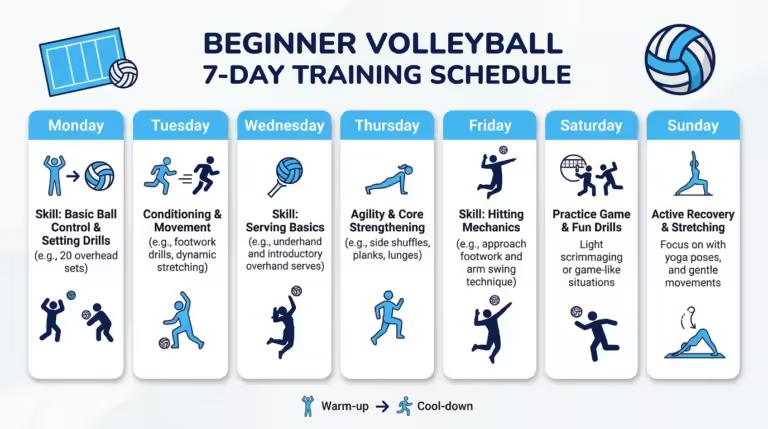
A Simple 7-Day Volleyball Training Schedule for Beginners
If you’re preparing for your first high school volleyball season, this beginner-friendly schedule can help you build consistency.
| Day | Training Focus | Suggested Activities |
|---|---|---|
| Monday | Passing | Wall passing and partner passing |
| Tuesday | Serving | Underhand and overhand serve practice |
| Wednesday | Setting | Wall setting and target setting |
| Thursday | Fitness | Squats, lunges, planks, and agility |
| Friday | Attacking | Approach footwork and arm swing |
| Saturday | All-around skills | Passing, setting, serving, and defense |
| Sunday | Recovery | Rest, mobility, and light stretching |
Start with 20–40 minutes per session, depending on your fitness and experience.
Adjust the schedule to your school’s team practices, physical education activities, and recovery needs. Avoid training through pain or exhaustion.
Common Mistakes High School Volleyball Beginners Should Avoid
Every beginner makes mistakes. The important thing is to recognize them and work on improving.

Here are some common mistakes to avoid:
- Standing too upright: Bend your knees and stay ready to move.
- Using bent arms when passing: Maintain a stable forearm platform.
- Watching the ball without moving: Adjust your feet to get behind the ball.
- Poor communication: Call the ball early and clearly.
- Serving without a target: Develop control before focusing on power.
- Incorrect rotation: Learn your rotational position before the serve.
- Jumping without proper technique: Practice safe takeoff and landing mechanics.
- Ignoring defense: Every player should learn basic defensive skills.
- Giving up after mistakes: Stay focused and prepare for the next rally.
- Skipping recovery: Give your body enough time to rest and recover.
Can You Join High School Volleyball If You’re a Beginner?
Yes! Many students start learning volleyball in high school without previous competitive experience.
However, whether you can join the team depends on your school’s program, available roster positions, tryout requirements, and competition rules.
If you are a beginner, focus on building your fundamental skills and demonstrating a willingness to learn.
Here are some practical ways to get started:
- Ask your school’s athletic department about volleyball tryouts.
- Contact the volleyball coach for practice information.
- Join beginner volleyball clinics if available.
- Practice with friends or classmates.
- Watch volleyball matches to understand the game.
- Develop basic fitness and coordination.
- Stay consistent with your training.
Remember that improvement takes time. Your first goal should be to become a confident and reliable teammate.
Frequently Asked Questions About High School Volleyball
1. What age do you start high school volleyball?
Most high school volleyball players are approximately 14–18 years old, although ages vary depending on school systems and grade levels.
2. Can beginners play high school volleyball?
Yes. Beginners can try out for high school volleyball teams. Team selection depends on the coach, available positions, skill level, and school requirements.
3. How many players are on a high school volleyball team?
Six players from each team are on the court during traditional indoor volleyball. The total team roster can include additional substitute players.
4. How long is a high school volleyball match?
Match duration varies depending on the number of sets, scoring, timeouts, substitutions, and length of rallies. Many matches last approximately 60–90 minutes, but some are shorter or longer.
5. What position should a beginner play in volleyball?
There is no single best position for every beginner. Try different skills and see what you enjoy. Your coach can help identify a position that matches your abilities.
6. What should I bring to high school volleyball practice?
Bring volleyball shoes, knee pads if needed, athletic clothing, a water bottle, and a positive attitude. Your coach may recommend additional equipment.
7. Is high school volleyball difficult?
Volleyball can be challenging when you first start because it requires coordination, communication, and technical skills. However, regular practice makes the game easier to understand and play.
8. How can I improve at high school volleyball?
Practice passing, setting, serving, attacking, and defensive movement consistently. Listen to your coach, develop physical fitness, and learn from every practice session.
Final Thoughts: Start Your High School Volleyball Journey With Confidence
High school volleyball is an excellent opportunity to learn new skills, build friendships, improve fitness, and become part of a team.
If you are a beginner, don’t worry about mastering every skill immediately. Start with the fundamentals, understand the rules, practice regularly, and stay positive.
Focus on improving your passing, setting, serving, communication, and defensive techniques. As your confidence grows, you can explore more advanced skills and discover which volleyball position suits you best.
At BeginnerVolleyball.com, we’re here to help you learn volleyball one skill at a time.
Keep practicing, stay motivated, and enjoy your volleyball journey!
Learn More With BeginnerVolleyball.com
Explore more beginner-friendly volleyball training guides:
- Volleyball Positions Explained: A Complete Beginner’s Guide.
- Volleyball Practice Plans for Beginners: A Simple Weekly Guide.
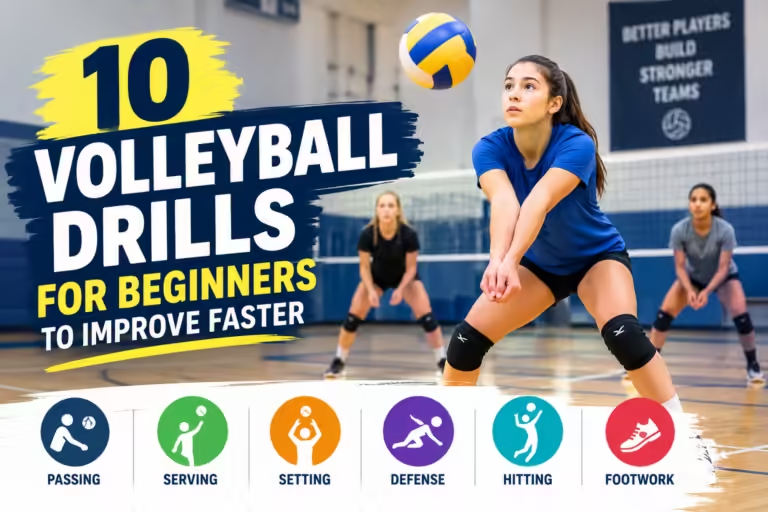
- 10 Volleyball Drills for Beginners to Improve Faster.
Train Smart • Play Better • Improve Every Day