
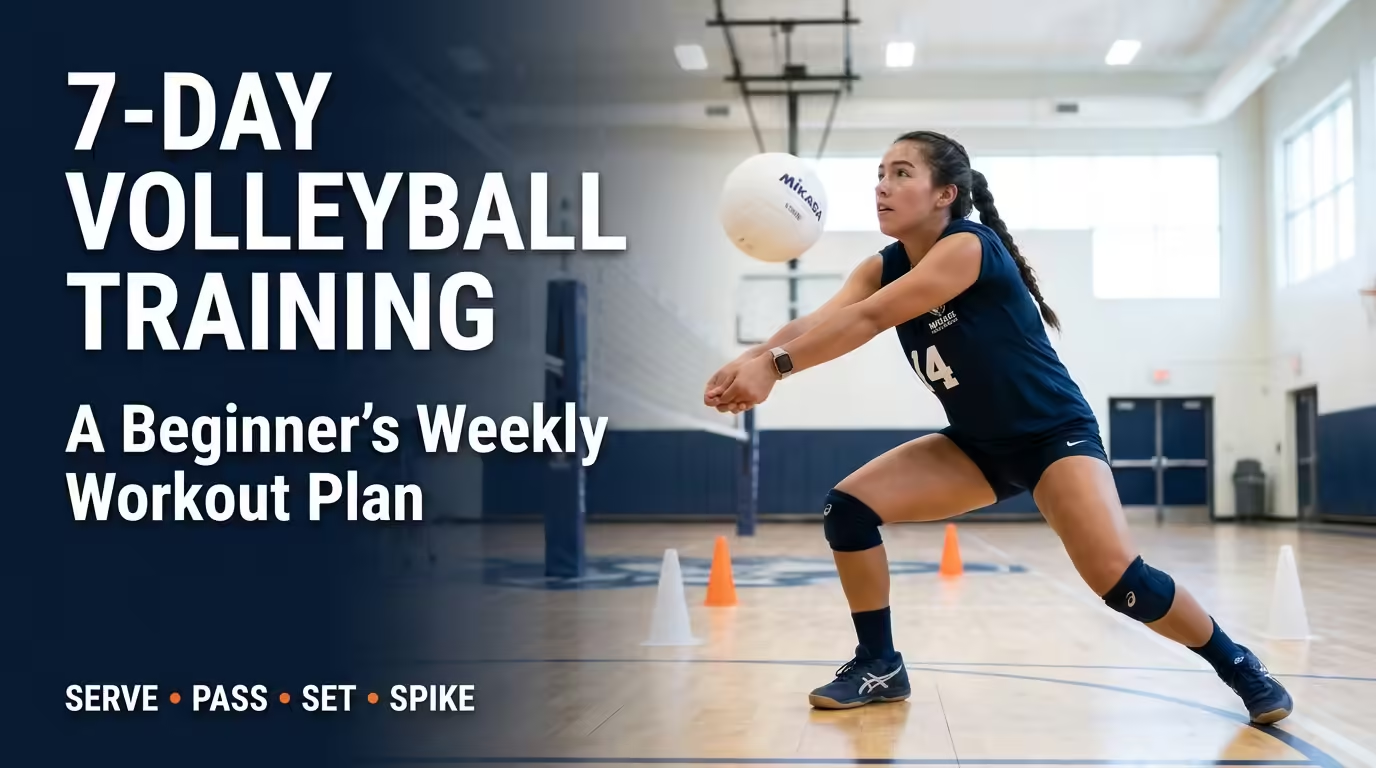
Build a complete game with this proven 7-day volleyball training schedule. Includes daily drills, strength work, recovery protocols, and image prompts for coaches and players.
Why a 7-Day Schedule Changes Everything
Most volleyball players train hard but train randomly. They play a few games, do some peppering, and hope for the best. The result? Stalled skill development, nagging injuries, and inconsistency under pressure.
A structured 7-day volleyball training schedule solves that problem. It forces you to balance skill acquisition, physical development, and recovery—the three pillars of volleyball performance. Research on strength and conditioning for volleyball shows that elite programming uses a 7-day cycle with varying training zones, alternating high-intensity days with active recovery and rest. A well-built week doesn’t just make you sweat; it makes you better.
This guide gives you a complete weekly framework you can run as a player or a coach. Every day has a purpose. Every drill has a coaching focus. And every section comes with an image prompt so you can create visuals that reinforce the plan.
The Weekly Blueprint at a Glance
| Day | Focus | Training Zone | Duration |
|---|---|---|---|
| Monday | Ball control & serve receive | Moderate–High | 90 min |
| Tuesday | Strength & power (lower body) | High | 60–75 min |
| Wednesday | Active recovery & mobility | Low | 30–45 min |
| Thursday | Position-specific skill work | Moderate | 90 min |
| Friday | Strength & power (upper body + jumps) | High | 60–75 min |
| Saturday | Team play / 6v6 competition | High | 90–120 min |
| Sunday | Full rest or light mobility | Rest | — |
This framework follows the principle of hard–easy–hard–easy sequencing. High-intensity days are sandwiched between recovery or lower-load sessions, which keeps quality high and injury risk low.
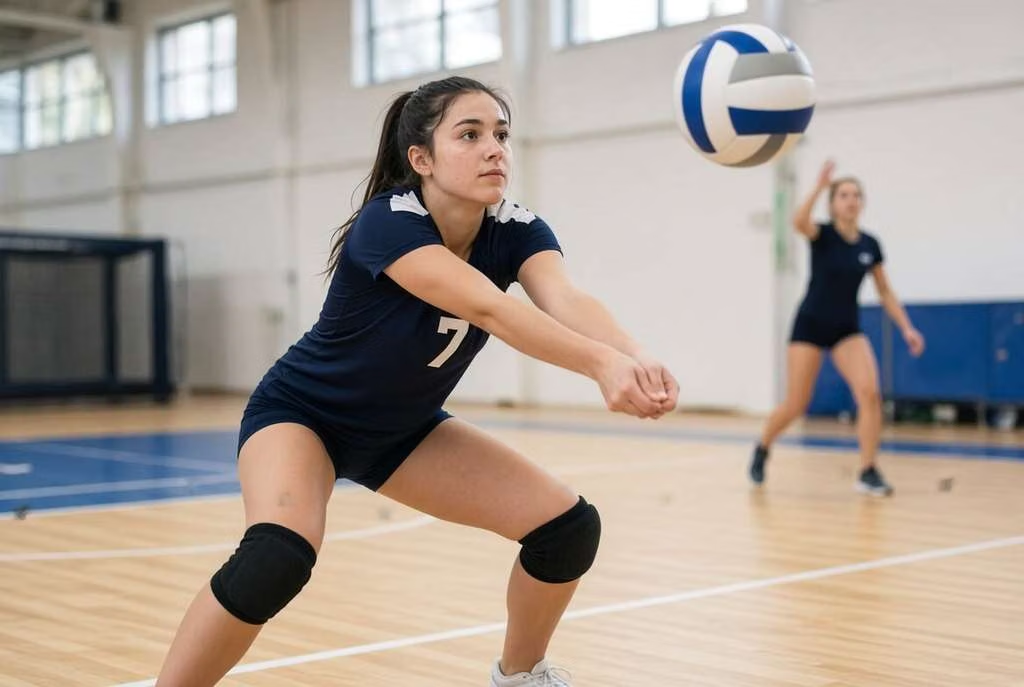
Day 1 (Monday): Ball Control & Serve Receive
Why it matters: Serve receive is where rallies are won or lost. More youth matches are decided at the pass than anywhere else, yet many players treat it as an afterthought. Monday sets the tone for the week with high-quality touches and a clear technical focus.
Session Structure (90 minutes):
- Dynamic warm-up (10 min): Shoulder rolls, ankle mobility, lateral shuffles, and arm swings. Start on time; the net should already be up.
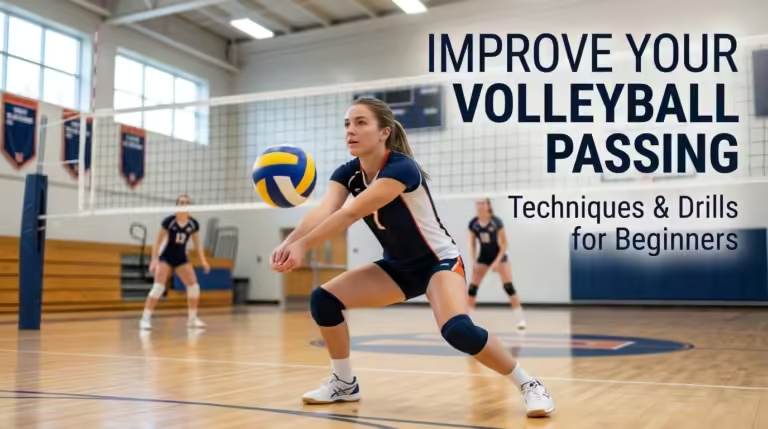
- Ball control & pepper (15 min): Pairs or triangles. Focus on platform angle and a clean first contact. Count consecutive good touches and try to beat your score each round.Players who want extra passing reps outside team practice can use a volleyball passing trainer with resistance bands for solo practice and skill training to reinforce platform control and repeatable form at home
- Serve receive waves (20 min): Groups of three passers. Servers aim for targets; passers aim for a rating goal (e.g., a 3-point pass to the setter). Chart makes and misses.
- Position-specific passing (20 min): Outside hitters work on angle passes; liberos work on reading float serves. One coaching point per group.
- 6v6 wash drill (20 min): Start every rally with a serve. Bonus points for perfect passes. This puts the day’s focus under game pressure.
- Cooldown & huddle (5 min): One takeaway per player. Preview the week. You Can Learn How to Set a Volleyball Correctly: Step-by-Step Guide
Day 2 (Tuesday): Strength & Power — Lower Body
Why it matters: Volleyball is a jumping sport. Vertical power comes from the hips, glutes, and quads. A dedicated lower-body strength day builds the foundation for a higher spike touch and a more explosive block.
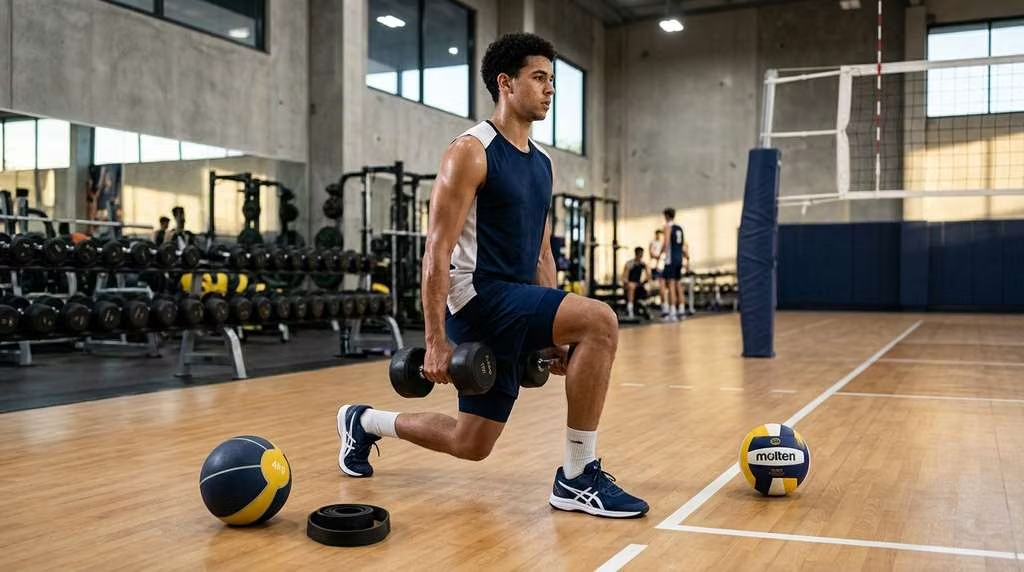
Sample Session (60–75 minutes):
| Exercise | Sets × Reps | Notes |
|---|---|---|
| Romanian deadlift | 3 × 12 @65% | Builds hamstring and glute strength |
| Back squat | 3 × 5 @80% | Primary vertical force driver |
| Clean high pull | 3 × 2 @85% | Explosive triple extension for jumping |
| Standing calf raise | 3 × 10 @70% | Ankle resilience for landing |
| Core circuit (plank, dead bug, Pallof press) | 2 rounds | Anti-rotation and trunk stability |
Coaching note: Percentages refer to your estimated 1-rep max. If you are new to lifting, start with bodyweight or light dumbbells and focus on technique. The goal is quality movement, not ego lifting. The National Strength and Conditioning Association (NSCA) is the leading authority on strength training. Its library includes articles specifically on volleyball, such as a five-week off-season program for collegiate female athletes and a guide on enhancing power and vertical jump in hitters. This is ideal for coaches and serious athletes.
Day 3 (Wednesday): Active Recovery & Mobility
Why it matters: Recovery is not a day off from improvement—it is part of improvement. Light movement increases blood flow to sore muscles and helps clear metabolic waste without adding fatigue.
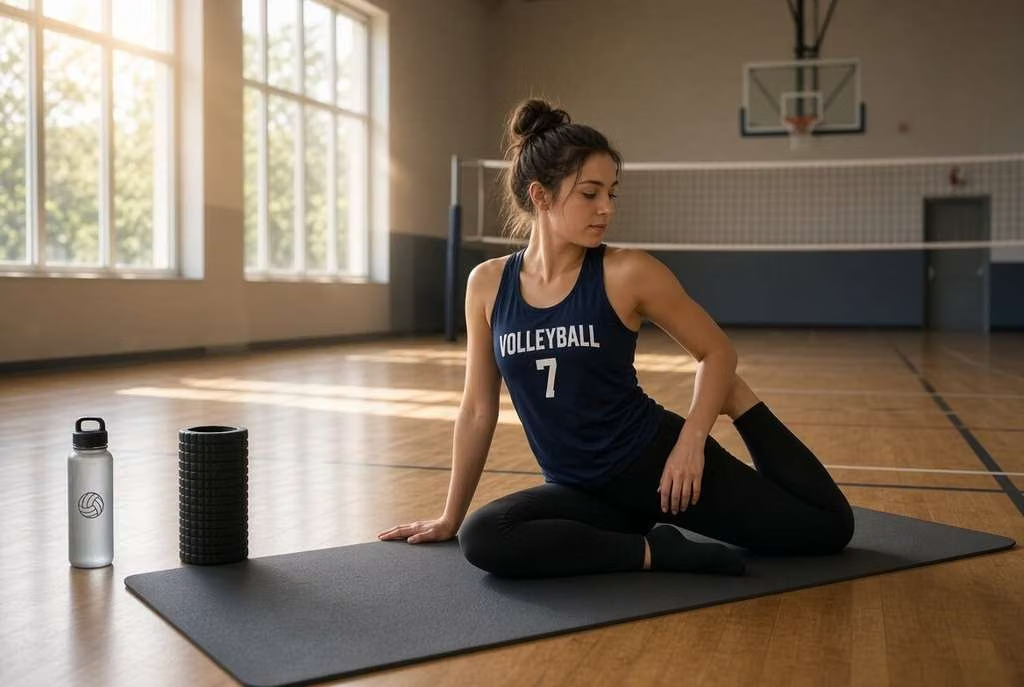
Recovery Session (30–45 minutes):
- Light walk or bike (10–15 min): Low intensity, conversational pace. The goal is circulation, not sweat.
- Full-body mobility flow (15 min): Hip openers, ankle circles, thoracic rotations, shoulder dislocates with a band. Hold each position for 30–45 seconds.
- Foam rolling (10 min): Quads, calves, lats, and thoracic spine. Avoid rolling directly on the lower back.
- Breathing & downregulation (5 min): Box breathing (4-4-4-4) to shift the nervous system into recovery mode.
Day 4 (Thursday): Position-Specific Skill Work
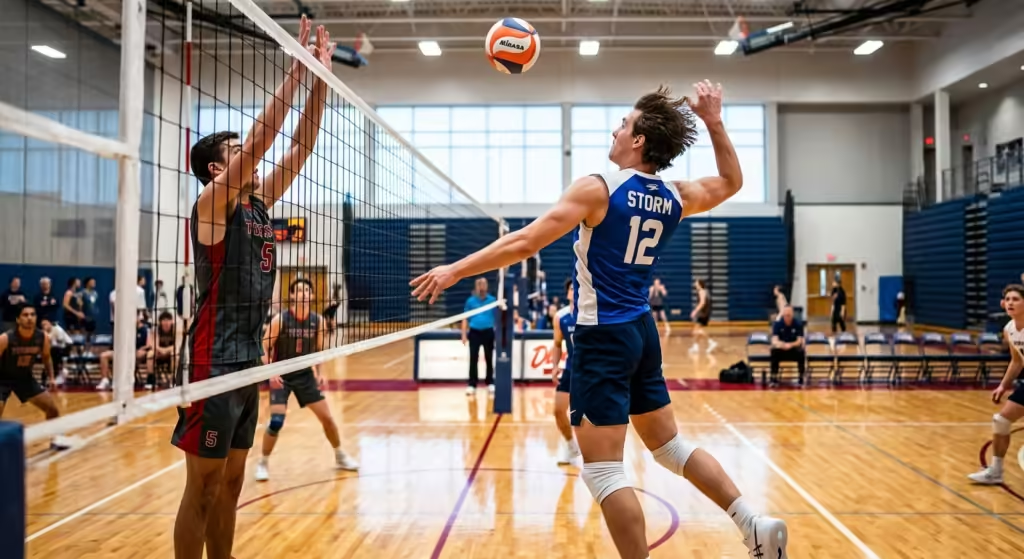
Why it matters: General drills make decent players. Position-specific training makes valuable players. Thursday isolates the skills that matter most for each role on the court.
Session Structure (90 minutes):
- Warm-up & pepper (15 min): Same framework as Monday, but add a positional constraint (e.g., setters only set, hitters only attack).
- Setter training (20 min): Footwork to the pin, hand positioning, decision-making on back-row attacks. Use a box or target net.
- Hitter training (20 min): Approach footwork, arm swing, shot selection (line, cross-court, tip). Coach tosses from different positions.
- Blocker training (20 min): Footwork along the net, hand penetration, reading the setter’s shoulders.
- Team transition drill (15 min): Block-to-hit transition. A middle blocker closes the block, lands, and immediately transitions to an attack approach.
Day 5 (Friday): Strength & Power — Upper Body + Jump Prep
Why it matters: The arm swing and block require shoulder stability, thoracic power, and reactive strength. Friday primes the upper body and the nervous system for Saturday’s competition.

Sample Session (60–75 minutes):
| Exercise | Sets × Reps | Notes |
|---|---|---|
| Pull-up (or assisted) | 3 × 5 @80% | Lat and shoulder girdle strength |
| Shoulder press | 3 × 10 @70% | Overhead stability for blocking and hitting |
| Bench press throw | 3 × 3 @40–60% | Explosive upper-body power |
| Power clean | 2 × 3 @60–80% | Full-body explosiveness |
| Med ball rotational throws | 3 × 5 each side | Core power transfer for the swing |
Coaching note: Keep volume moderate. Friday is about activation, not exhaustion. You want to feel springy and sharp for Saturday, not sore.
Day 6 (Saturday): Team Play & 6v6 Competition
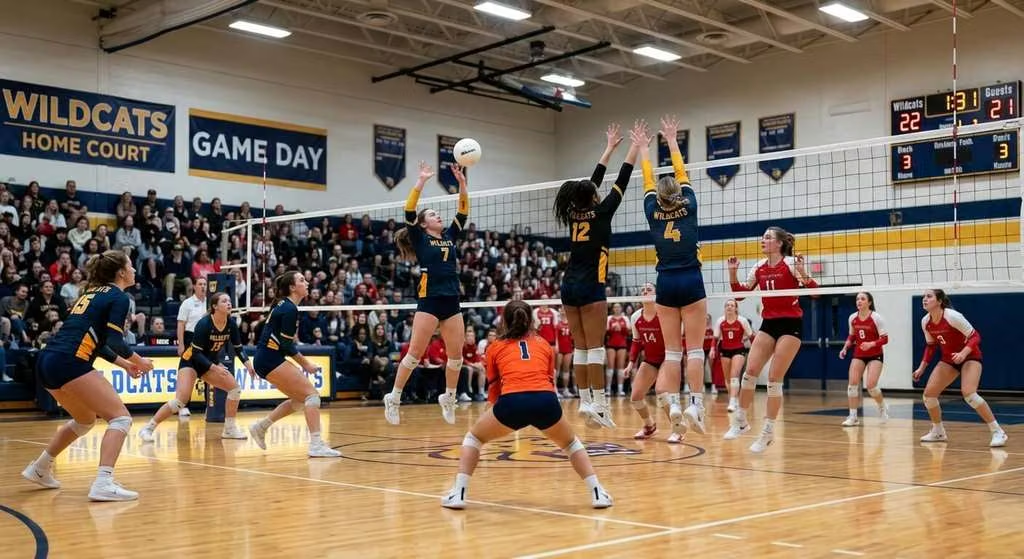
Why it matters: Skills are built in isolation but proven in chaos. Saturday is the integration day—the session where every drill from the week comes together under match-like pressure.
Session Structure (90–120 minutes):
- Match warm-up (15 min): Dynamic warm-up followed by hitting lines and serving. Mimic a real pre-match routine.
- Serve and receive under pressure (20 min): Score-based drill. Serving team earns a point for an ace; receiving team earns a point for a perfect pass. Play to 15.
- 6v6 with constraints (40–50 min): Play full games with one rule that forces the week’s focus (e.g., “every attack must come from a transition” or “the middle must touch the ball on every rally”).
- Wash scoring (15–20 min): Start each rally with a serve. First team to 10 wins. Keep individual statistics if possible.
- Cooldown & debrief (10 min): What worked? What needs next week’s attention?
Day 7 (Sunday): Full Rest or Light Mobility
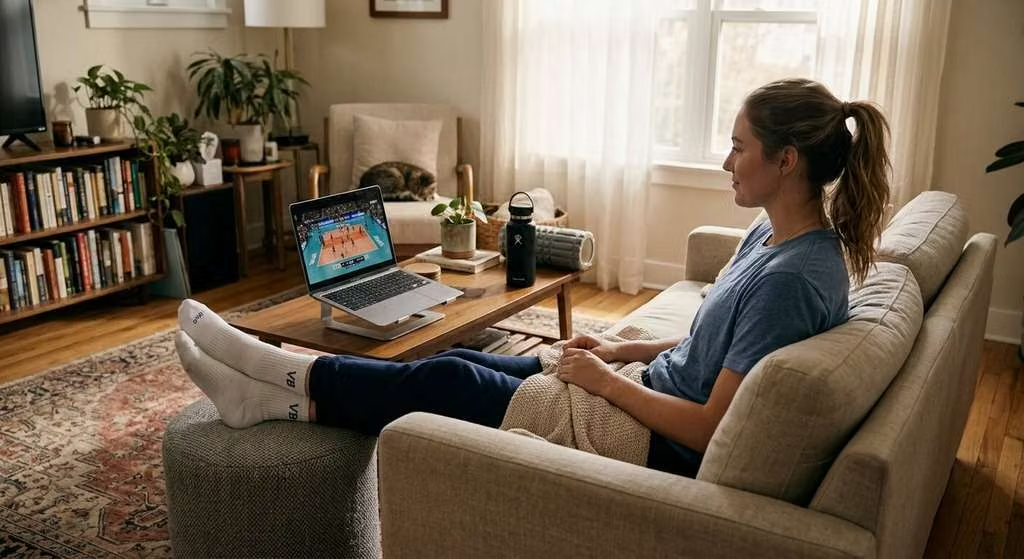
Why it matters: The body adapts during rest, not during training. A full day off—or a very light mobility session—consolidates the week’s gains and reduces the risk of overuse injuries.
Options for Sunday:
- Full rest: No structured exercise. Walk, stretch casually, hydrate, and sleep.
- Light mobility (15–20 min): Gentle yoga flow, foam rolling, or a short walk. Keep intensity low enough that you could hold a conversation.
How to Adapt the Schedule to Your Level
| Level | Weekly Practice Volume | Key Adjustment |
|---|---|---|
| Beginner | 2–3 practices/week | Combine skill days; keep strength sessions to bodyweight or light weights |
| Intermediate | 3–5 practices/week | Follow the 7-day structure but reduce strength volume by 20–30% |
| Advanced / Competitive | 5–8 sessions/week | Add a second skill session on Wednesday (light technical work) and increase strength loads progressively |
The schedule is a template, not a prison. If you have a match on Wednesday, shift the hard days earlier and protect the 48 hours before competition.
Recovery & Nutrition Non-Negotiables
A 7-day schedule only works if you recover between sessions.
- Sleep: 7–9 hours per night. This is the single most powerful recovery tool.
- Protein: Aim for 1.6–2.0 g of protein per kg of body weight daily to support muscle repair.
- Hydration: Drink water throughout the day, not just during practice. Add electrolytes for sessions over 60 minutes.
- Active recovery: Wednesday and Sunday are not “lazy days”—they are adaptation days that make the hard days possible.
Frequently Asked Questions
Is a 7-day volleyball training schedule too much?
Not if it is structured correctly. The schedule includes two high-intensity strength days, two skill days, one competition day, and two recovery/rest days. The hard–easy rhythm prevents burnout and overtraining.
Can I do this schedule in-season?
Yes, but reduce the strength volume. During the competitive season, prioritize skill work and team play, and use strength sessions for maintenance rather than building.
What if I only have 45 minutes per day?
Focus on the first three blocks of each session: warm-up, primary drill, and cooldown. Cut the accessory work, not the main skill focus.
Can I train volleyball alone?
Yes. Solo drills like wall passing, toss-and-pass, and resistance-band passing trainer work can build platform consistency when you do not have a partner.
How long should a volleyball practice be?
For club and school teams, 90 minutes is the standard. For players 12 and under, 75 minutes is plenty. Inside any time slot, keep at least half the session for serve-receive and 6v6 play.
Final Word
A 7-day volleyball training schedule is the difference between hoping to improve and planning to improve. Use this blueprint as your weekly operating system: build skills on Monday and Thursday, build strength on Tuesday and Friday, compete on Saturday, and respect recovery on Wednesday and Sunday.


2 Comments