
Learn NCAA volleyball rules for 2026–2027, including center-line faults, challenges, timeouts, rotations, jewelry, and important women’s volleyball rule changes. This guide explains the most important NCAA volleyball rules for new fans, players, and coaches.
NCAA volleyball is fast-paced, competitive, and exciting—but understanding the rules makes every rally easier to follow. Whether you’re a new fan, a player, a coach, or a student learning the game, knowing how scoring, rotations, challenges, and penalties work will help you understand what happens on the court.
This guide to NCAA volleyball rules covers 15 essential rules and important updates for the 2026–2027 season, with special attention to the official NCAA women’s volleyball changes.
Important scope note: Several changes discussed below were approved for NCAA women’s volleyball beginning with the 2026 season. NCAA men’s volleyball has its own rulebook and modifications. Always check the official rules for the division and competition you’re watching.
Quick Overview of NCAA Volleyball Rules
| Rule | General explanation |
|---|---|
| Players | Six players per team are normally on the court |
| Scoring | Rally scoring awards a point after each rally |
| Match format | Standard indoor matches generally use best-of-five scoring |
| Set targets | Usually 25 points for the first four sets and 15 for the fifth |
| Winning margin | A team must win a set by two points |
| Team contacts | Teams normally have up to three hits, excluding a qualifying block contact |
| Rotation | Players follow the required rotation order when gaining the right to serve |
| Center-line fault | A player’s foot completely crossing the center line is a fault under the new NCAA women’s rule |
| Video challenges | Coaches use the prescribed challenge signal and must follow challenge procedures |
| Official reference | NCAA women’s and men’s playing-rules resources |
The table summarizes general indoor-volleyball principles. Specific procedures and exceptions are governed by the applicable NCAA rulebook.
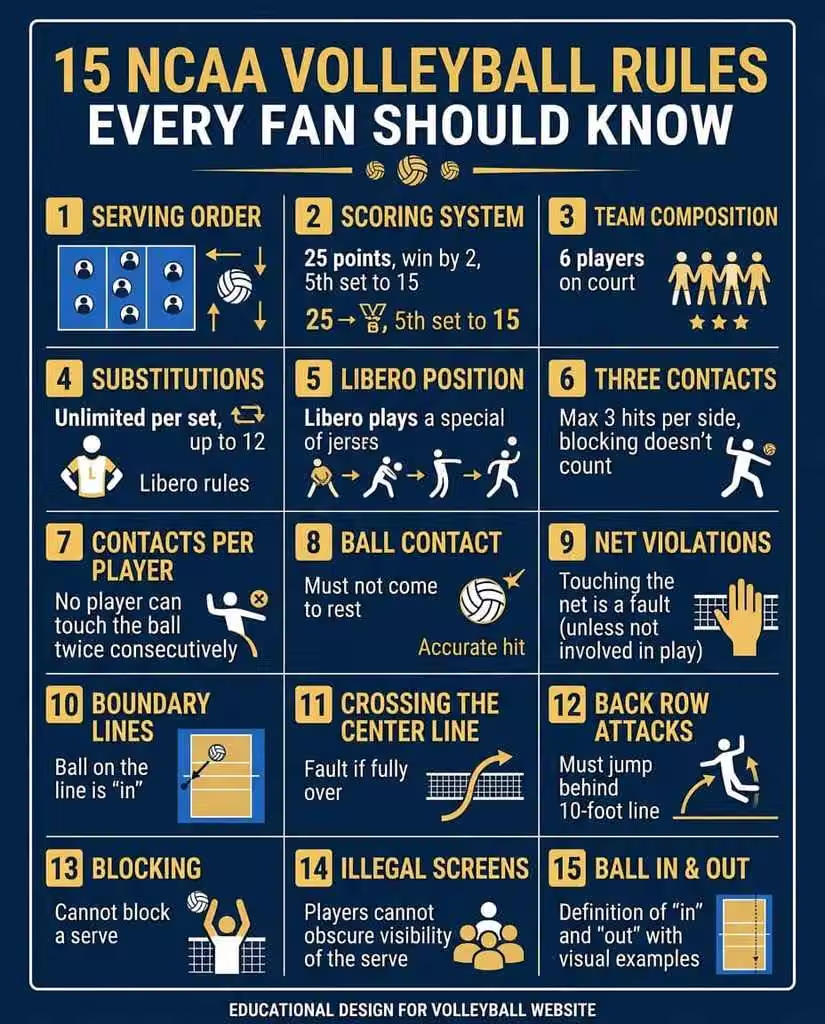
1. NCAA Volleyball Uses Rally Scoring
Under rally scoring, a point is awarded after every rally, regardless of which team served.
For example, if Team A serves but Team B wins the rally, Team B earns a point and gains the right to serve. If Team A wins the rally, Team A scores and continues serving.
This system means that every rally matters, making serving, passing, blocking, and defensive play important throughout the match. Understanding NCAA volleyball rules makes rally scoring and set formats easier to follow.
2. Matches Generally Follow a Best-of-Five Format
A standard NCAA indoor volleyball match generally follows a best-of-five format. The first team to win three sets wins the match.
The match can finish in three, four, or five sets. If one team wins the first three sets, there is no need to play additional sets.
Always check the official competition regulations for any specific format modifications.
3. Teams Must Win Sets by Two Points
A team must lead by at least two points to win a set.
For example, if the score reaches 24–24, play continues until one team establishes a two-point advantage. A score of 26–24 satisfies that requirement, while 25–24 does not.
The same principle applies to the deciding set.
4. The Fifth Set Has a Different Target Score
In the standard best-of-five format, the first four sets are generally played to 25 points, and the fifth set is generally played to 15 points.
The two-point winning margin still applies. A deciding set tied at 14–14 must continue until a team leads by two points.
5. Six Players Normally Play on the Court
Six players from each team normally participate on the court during a rally.
Common positions include:
- Setter
- Outside hitter
- Opposite hitter
- Middle blocker
- Libero
- Defensive specialist
The exact lineup depends on the team’s tactics and the applicable lineup and substitution rules.
6. Teams Normally Have Three Hits to Return the Ball
A team generally has up to three hits to send the ball back over the net. A typical sequence is a pass, a set, and an attack.
A qualifying block contact is treated separately under the team-hit rule. This means a team can generally make a block contact and still have up to three additional team hits.
A fourth team hit generally results in a fault.
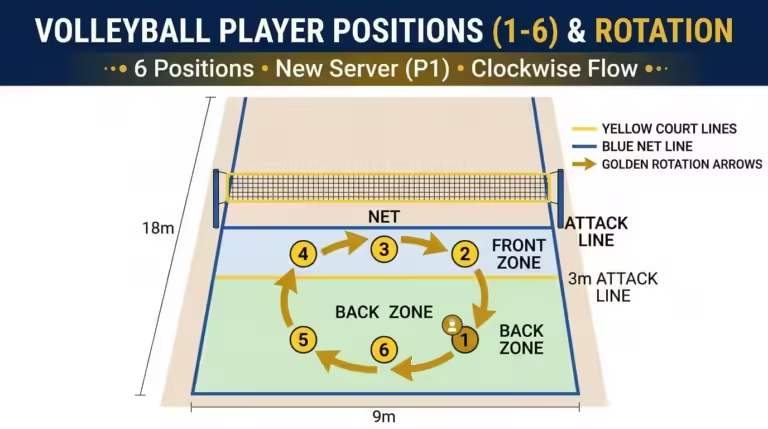
7. Players Must Follow the Rotation Order
When the receiving team wins a rally and gains the right to serve, its players rotate one position clockwise according to the required rotation order.
Players can move into their tactical positions after the serve, but the team must satisfy the applicable positional requirements at the time the ball is served.
An incorrect rotation or positional alignment can result in a fault. Rotation is one of the NCAA volleyball rules players must understand before competing.
8. A Foot Completely Crossing the Center Line Is a Fault
One of the significant NCAA women’s volleyball changes for the 2026 season concerns the center line.
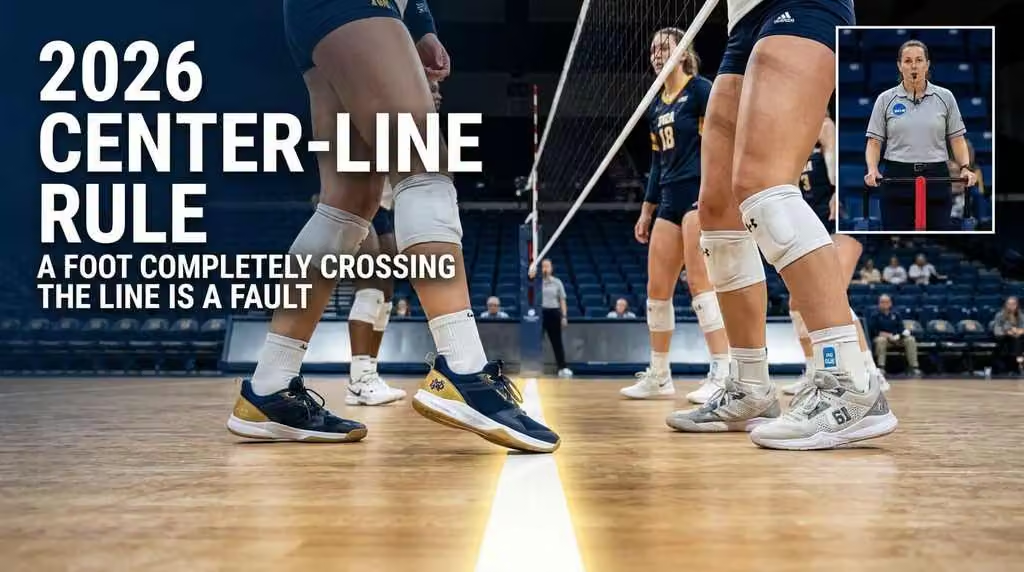
Under the new rule, a player’s foot completely crossing the center line is ruled a fault. Previously, the action was not automatically a fault unless it caused interference or created a safety hazard.
Coaches can challenge whether an opponent’s foot completely crossed the center line. Officials may also review possible net faults as part of a challenge involving this center-line decision.
This change makes the ruling more consistent and brings NCAA women’s volleyball closer to the international rule.
Why fans should know: A player can lose a point for a center-line fault even if the ball itself appears to have been played successfully. The official ruling depends on the applicable rule and the facts of the play. This NCAA volleyball rule update clarifies when a player commits a center-line fault.” Only use if accurate for the competition covered.
9. Players May Pursue Certain Balls Around the Net Pole
Under the applicable NCAA women’s volleyball rule change, a player may go around the net pole to pursue a ball and play it back to their own side in a qualifying situation.
The rule applies when the ball has crossed the net plane into the opponent’s free zone over or outside the antenna. The player must return the ball over or outside the antenna on the same side, and the player cannot go under the net to retrieve it.
The playing facility must also meet the required clearance conditions, including at least two meters of space behind the first referee’s platform and the specified clearance near the net standard and scorekeeper’s table. Media equipment or personnel restrictions also apply in the relevant area.
This rule allows certain extended rallies to continue when a player chases a ball outside the normal court area.
10. Coaches Must Follow the Video Challenge Procedure
NCAA women’s volleyball has updated how coaches request a video challenge.
Under the approved procedure, a coach makes a “C” shape with the hands to request a challenge rather than presenting a card.
Challenges cannot be initiated once a timeout has started. Center-line faults are now among the reviewable decisions, and a challenge involving a center-line fault may also allow officials to examine a possible net fault.
Not every decision is automatically reviewable. The applicable challenge system and rules determine which calls can be reviewed and how the review is conducted. Video challenges help officials review certain decisions under applicable NCAA volleyball rules.
11. Misconduct Sanctions and Delay Sanctions Are Different
The 2026 NCAA women’s volleyball changes distinguish between misconduct sanctions and procedural delay sanctions.
- Misconduct sanctions: These remain in effect for the entire match rather than resetting when a set ends.
- Delay sanctions: These reset for each set under the approved changes.
The distinction matters because a team or individual cannot assume that a misconduct sanction disappears after a set ends.
The NCAA also approved a two-game suspension consequence when a disqualified player or coach fails to serve the required next-game suspension. The specific rule applies according to the circumstances stated in the NCAA regulations.
12. Timeout Rules Include an Optional Technical/Media Format
The NCAA women’s volleyball changes add an optional timeout format for applicable competitions.
Under that format:
- A technical or media timeout occurs when a team reaches 15 points in sets one through four.
- The technical or media timeout can last up to 90 seconds.
- A regular team timeout can last up to 75 seconds.
- There is no technical or media timeout in the fifth set under this format.
Because the format is optional, fans should not assume every NCAA women’s volleyball match uses it. The competition’s rules and media arrangements determine which timeout format applies.
13. Court Logos Must Follow the Approved Restrictions
The NCAA women’s volleyball changes permit two commercial logos on the playing surface under the specified restrictions.
Each logo may be no larger than 10 feet by 10 feet, with one logo allowed at each end of the playing court between the attack line and end line. Logos must not interfere with required court markings or boundary lines.
This is a specific playing-surface regulation—not permission to place logos anywhere on the court.
14. Jewelry Is Restricted by Location
Under the approved NCAA women’s volleyball change, jewelry may be worn above the chin only, with no size limitation specified in the announcement. Jewelry below the chin remains prohibited under this rule.
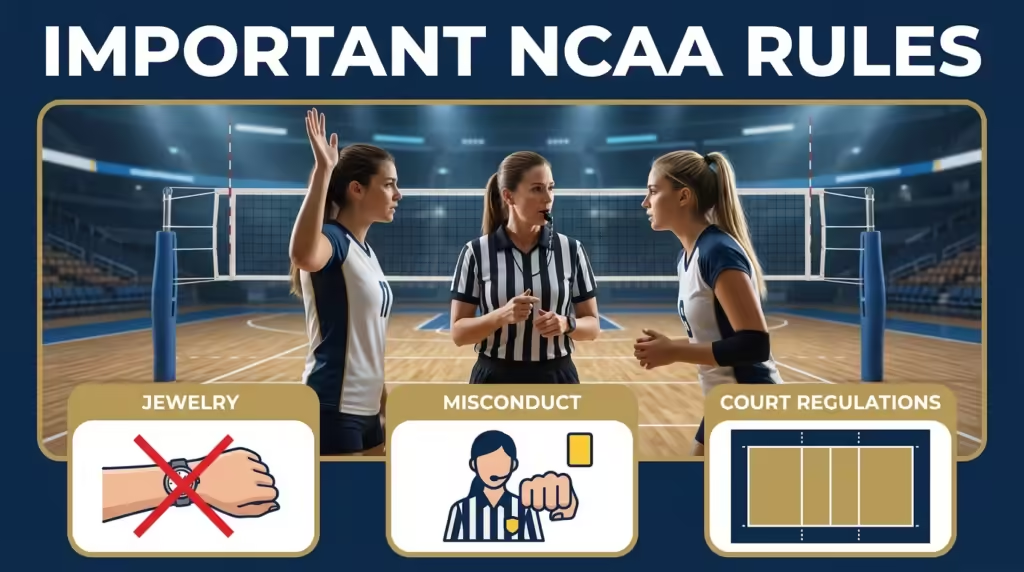
Players and coaches should follow the applicable officiating instructions and current rulebook rather than assuming that all jewelry is permitted.
15. Bench Changes and Fifth-Set Choices Follow Updated Procedures
The NCAA women’s volleyball changes also update bench and fifth-set procedures.
Bench changes: Teams switch benches after the completion of the second set, rather than switching after every set.
Fifth-set coin toss: The winner of the coin toss can choose to serve, receive, or select the side of the court. Under the updated procedure, teams remain on their chosen sides throughout the fifth set rather than changing sides when a team reaches eight points.
These changes are intended to improve the pace of play and reduce delays.
Common NCAA Volleyball Faults
Here are some important faults to recognize while watching a match:
- Service fault: A player violates an applicable service requirement.
- Four hits: A team uses more than its permitted team contacts.
- Ball out: The ball lands outside the court without touching a boundary line.
- Illegal contact: A player commits a prohibited ball-contact action.
- Rotation fault: Players fail to meet the required rotation or positional conditions.
- Net fault: A player commits prohibited net contact.
- Center-line fault: A player violates the applicable center-line rule.
- Illegal attack or block: A player commits an attack or blocking violation.
A referee applies the rule that matches the situation. Not every apparent mistake is automatically a fault.
NCAA Volleyball Rules: Official Sources
For the most accurate information, use the NCAA’s official resources:
- NCAA Women’s Volleyball Playing Rules — Official women’s rules and updates.
- NCAA Men’s Volleyball Playing Rules — Official men’s rules and modifications.
- NCAA announcement of 2026 women’s volleyball rule changes — Center-line faults, challenges, bench procedures, timeout options, jewelry, and other approved changes.
These primary sources should be checked whenever this article is updated for a new season.
Frequently Asked Questions About NCAA Volleyball Rules
What is the new center-line rule in NCAA women’s volleyball?
Starting with the 2026 season, a player’s foot completely crossing the center line is ruled a fault. Coaches can challenge whether an opponent’s foot completely crossed the line.
Can an NCAA volleyball player go around the net pole?
Under the applicable NCAA women’s rule, a player can pursue certain balls around the net pole when the ball crosses into the opponent’s free zone over or outside the antenna. The player must meet the specified conditions and cannot go under the net.
How long are NCAA volleyball timeouts?
Under the optional 2026 women’s technical/media timeout format, technical or media timeouts can last up to 90 seconds and regular team timeouts up to 75 seconds. The fifth set does not have a technical/media timeout under this format.
Can NCAA volleyball players wear jewelry?
Under the approved NCAA women’s volleyball change, jewelry is permitted above the chin only. Jewelry below the chin remains prohibited.
Do NCAA men’s and women’s volleyball have identical rules?
No. NCAA men’s and women’s volleyball have separate playing-rules resources and may have different rules or modifications. Always consult the rulebook for the specific competition.
Where can I find the official NCAA volleyball rulebook?
Visit the NCAA’s official women’s volleyball rules page or men’s volleyball rules page.
Final Thoughts
Understanding NCAA volleyball rules helps fans follow scoring, rotations, challenges, and referee decisions. The 2026 women’s volleyball updates introduce important changes to center-line faults, pursuit around the net pole, challenge procedures, timeout options, jewelry, misconduct sanctions, and bench protocols.
For accurate information, remember that rules can differ by division, competition, and season. Check the current official NCAA playing-rules resources before applying a rule to a specific match.

One Comment