
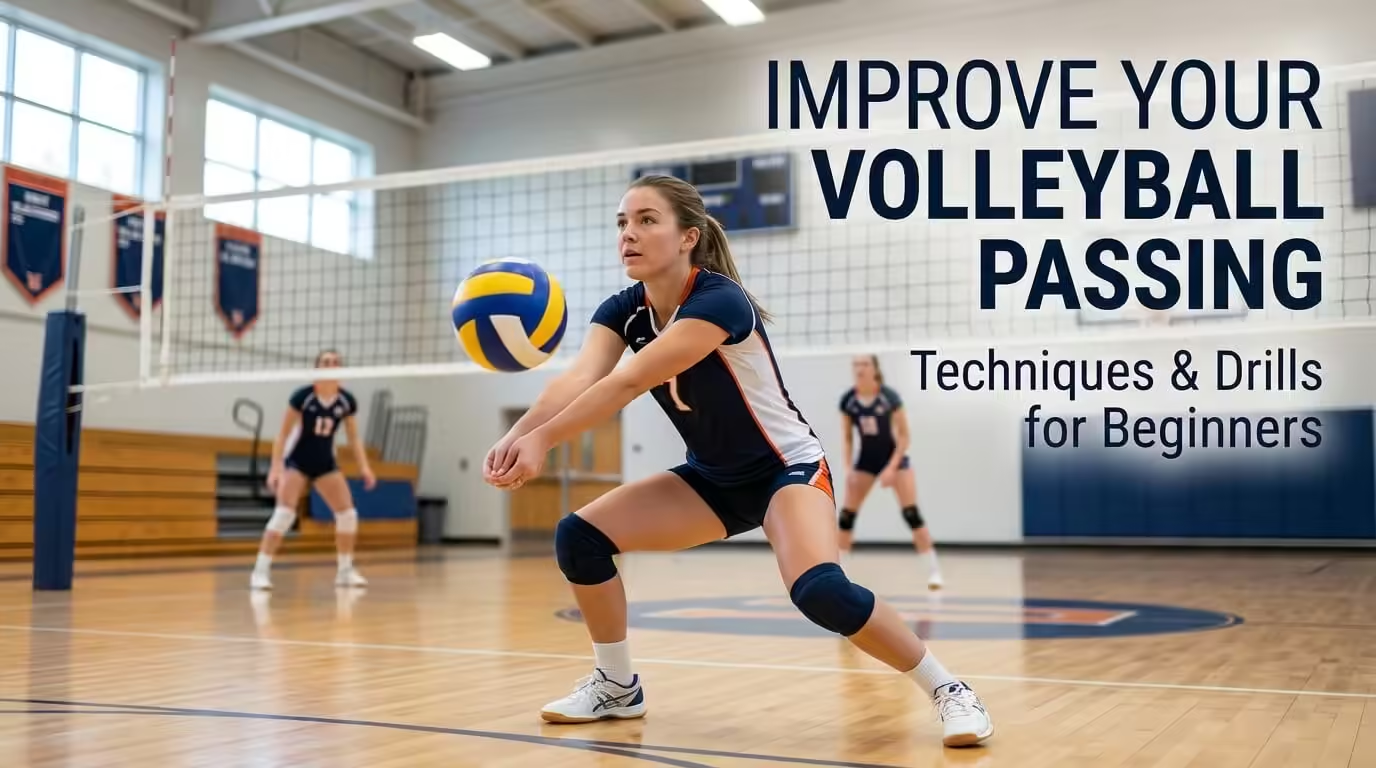
Learning how to improve volleyball passing takes consistent practice, correct body positioning, and good ball control. By following the right volleyball passing techniques and practicing simple drills regularly, beginners can develop accuracy and confidence on the court.
Volleyball passing is one of the most important skills every player needs to learn. Good passing helps your team control the ball, set up powerful attacks, and keep rallies alive. Whether you are a beginner or an experienced player, improving your passing technique can make a big difference in your performance.
If you want to learn how to improve volleyball passing, this guide covers the correct passing form, common mistakes to avoid, and effective volleyball passing drills you can practice at home or on the court.
Why Is Passing Important in Volleyball?
Understanding how to improve volleyball passing can help you receive serves more effectively, control difficult balls, and give your setter better opportunities to organize an attack.
Improving your passing skills can help you:
- Control the ball more consistently.
- Receive serves with greater accuracy.
- Improve communication with teammates.
- Make it easier for the setter to deliver accurate sets.
- Reduce unforced errors during matches.
- Build confidence in serve-receive situations.
For beginners, learning the correct passing technique should be a priority before moving on to more advanced skills.
1. Learn the Correct Volleyball Passing Technique
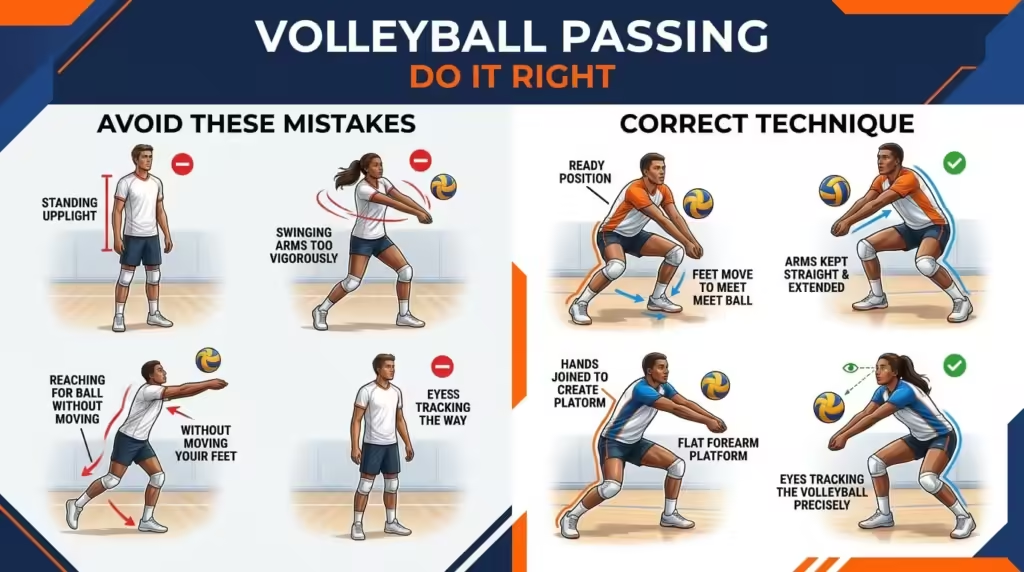
One of the first steps in how to improve volleyball passing is mastering the forearm platform. Keep your arms straight, move your feet toward the ball, and direct your pass toward your intended target.
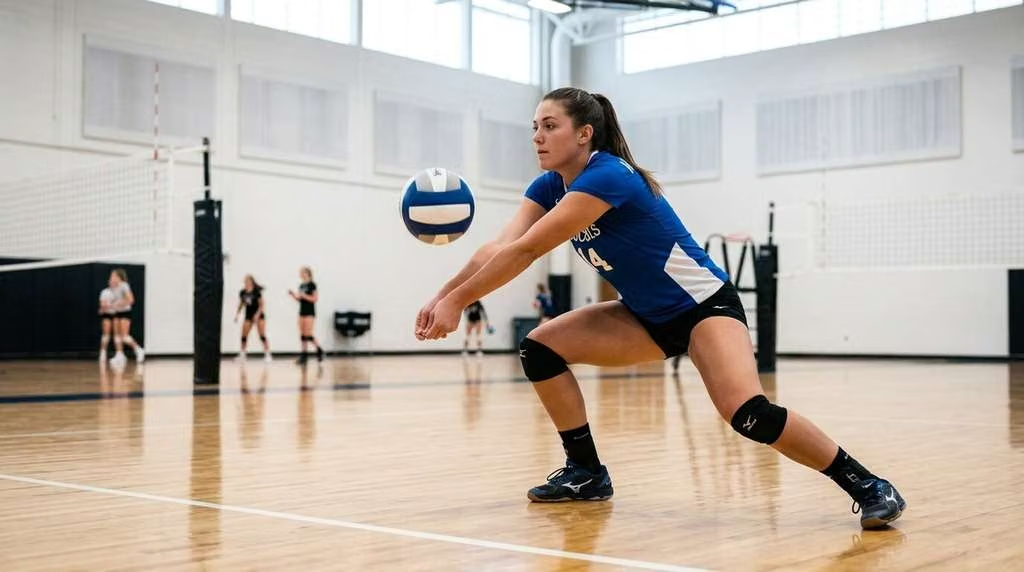
Step 1: Start in a Ready Position
Stand with your feet slightly wider than shoulder-width apart. Bend your knees, lean forward slightly, and keep your weight on the balls of your feet.
Keep your arms relaxed in front of your body so you can react quickly to the ball.
Tip: Avoid standing straight with locked knees. A balanced, low position helps you move quickly in any direction.
Step 2: Move Your Feet Toward the Ball
Try to move your feet so your body is behind the ball before making contact. Use short, controlled steps rather than reaching with your arms.
Positioning your body correctly makes it easier to direct the ball toward the setter.
Step 3: Create a Flat Forearm Platform
Bring your hands together and extend your arms in front of your body. Keep your elbows straight but avoid excessive tension in your shoulders.
Your forearms should form a relatively flat surface for the ball to contact.
You can place one hand inside the other and bring your thumbs together, pointing forward and downward slightly. Choose a hand position that feels comfortable while keeping your forearms aligned.
Step 4: Contact the Ball Correctly
Allow the ball to contact the flat area of your forearms, a few inches above your wrists. Keep your eyes on the ball and maintain a stable platform.
Avoid swinging your arms forcefully. Instead, use your legs and body positioning to help control the pass.
Step 5: Direct the Ball Toward the Target
Angle your platform toward the setter or your intended target. Small changes in your forearm angle can significantly affect the direction of the ball.
Keep your movements controlled and finish in a balanced position, ready for the next play.
2. Practice These 7 Volleyball Passing Drills
These volleyball passing drills are designed to help beginners learn how to improve volleyball passing through repetition, movement, and better control. Start with simple exercises before progressing to more challenging drills.
Drill 1: Wall Passing Drill
Wall practice is a useful exercise for anyone learning how to improve volleyball passing alone. Start with short, controlled passes and focus on returning the ball to a consistent height. Increase your repetitions as your technique becomes more reliable.
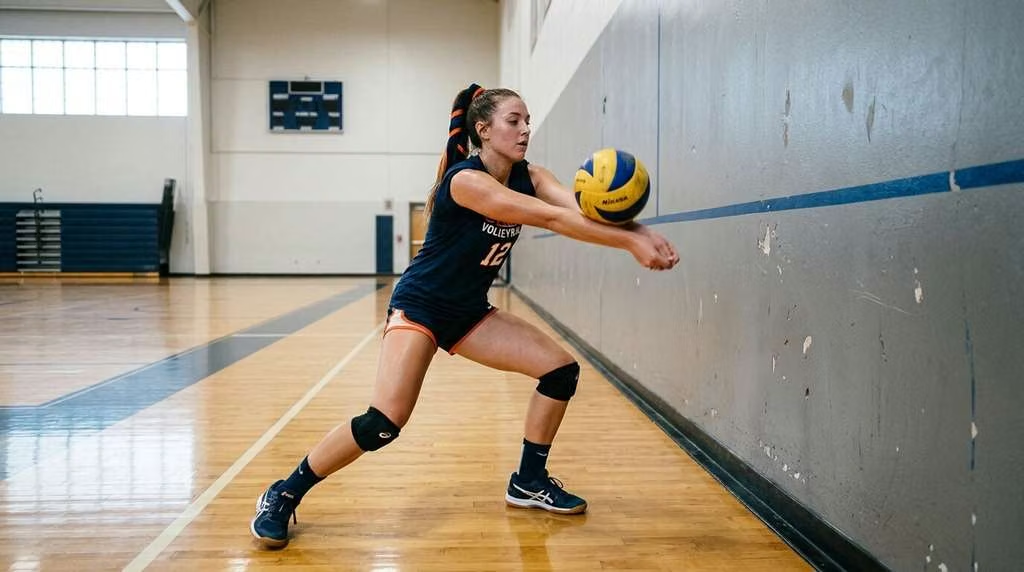
Goal: Improve control and consistency.
This is one of the easiest volleyball passing drills for beginners because you can practice alone.
How to do it:
- Stand a comfortable distance from a clear, sturdy wall.
- Hold your hands together and form a flat forearm platform.
- Toss the volleyball gently against the wall.
- Pass the returning ball back toward the wall.
- Maintain your ready position and repeat.
Start with 10–15 controlled passes. Gradually increase the number as your accuracy improves.
Beginner tip: Focus on making consistent contact rather than passing the ball as hard as possible.
Drill 2: Partner Passing Drill
Practicing with a teammate is another effective way to learn how to improve volleyball passing. Ask your partner to vary the direction of their tosses so you can work on footwork, positioning, and passing accuracy.
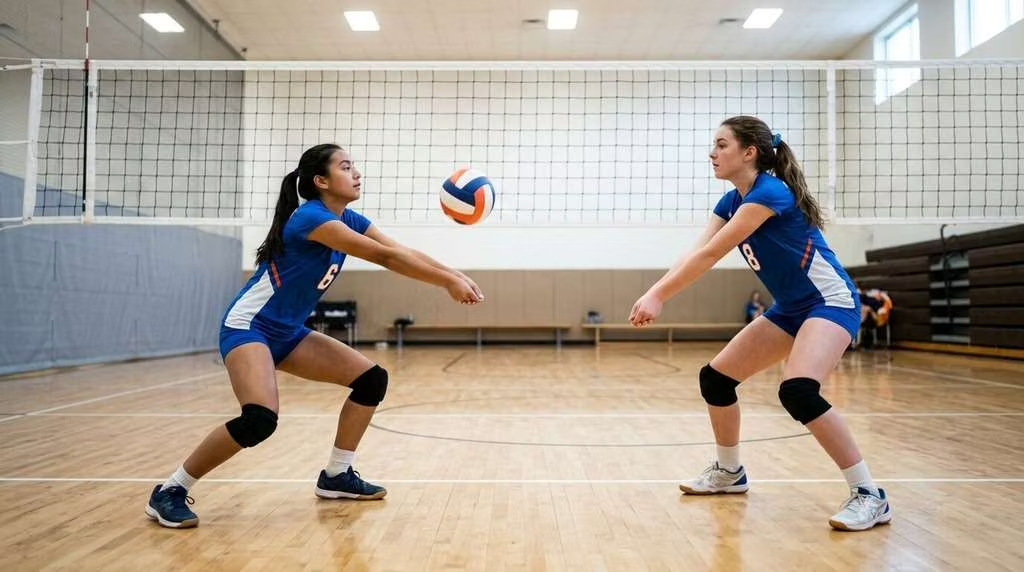
Goal: Develop accuracy and timing.
Partner passing helps you practice controlling balls coming from different distances.
How to do it:
- Stand approximately 6–10 feet apart.
- Have your partner toss the ball gently toward you.
- Pass it back using your forearms.
- Keep your platform angled toward your partner.
- Repeat for 15–20 passes, then switch roles if needed.
As you improve, increase the distance slightly or ask your partner to vary the direction of each toss.
Drill 3: Self-Toss and Pass Drill
Goal: Build confidence and improve contact consistency.
This drill works well when you do not have a partner.
How to do it:
- Toss the ball a short distance above your head.
- Move into position underneath the ball.
- Pass it upward using your forearms.
- Let the ball drop, catch it, and repeat.
- Try to keep each pass at a similar height.
Start with 10 repetitions and work toward 20 controlled passes.
Drill 4: Shuffle and Pass Drill
Goal: Improve footwork and movement.
In a real match, the ball rarely comes directly toward you. This drill teaches you to move into position before passing.
How to do it:
- Place two cones about 6–10 feet apart.
- Start in the middle in a low ready position.
- Shuffle toward one cone.
- Have a partner toss a ball toward that side.
- Pass the ball back, return to the center, and repeat on the opposite side.
Complete 8–12 passes in each direction. Keep your feet moving and avoid crossing them during short lateral shuffles.
Drill 5: Target Passing Drill
Goal: Improve passing accuracy.
Set a target near the position where your setter would normally stand.
How to do it:
- Mark a target area on the court using cones or another safe marker.
- Have a partner toss balls toward you.
- Pass each ball toward the target.
- Count how many passes reach the target area.
- Repeat and try to improve your score.
Perform 15–20 attempts. Track your results each session to see your progress.
Drill 6: Serve-Receive Practice
Goal: Prepare for real match situations.
Serve-receive practice helps you react to the ball while maintaining proper passing technique.
How to do it:
- Take your ready position in the backcourt.
- Ask a partner to serve gently or toss balls from different locations.
- Move behind each ball before passing.
- Direct the pass toward the setter’s target area.
- Reset your position after every attempt.
Begin with predictable tosses before progressing to more challenging serves. If you are new to volleyball, prioritize control and safe movement.
Drill 7: Three-Player Passing Drill
Goal: Improve communication and team coordination.
This drill helps players connect passing with the next stage of a volleyball rally.
How to do it:
- Position three players in a small triangle.
- One player sends the ball to the receiver.
- The receiver passes toward the designated target player.
- The third player catches the ball or returns it with a controlled toss.
- Rotate positions after several repetitions.
Encourage players to call the ball early and give each other clear instructions. As the group improves, transition from catching to setting and controlled hitting.
3. Common Volleyball Passing Mistakes to Avoid
One important part of learning how to improve volleyball passing is identifying and correcting common mistakes. Keep your knees bent, move your feet before contacting the ball, and maintain a steady forearm platform. These simple adjustments can help you pass more accurately during practice and matches.
Swinging Your Arms Too Much
A large arm swing can send the ball too high or too far. Keep your platform steady and use your legs and body position to help guide the ball.
Standing Too Upright
Standing straight makes it harder to react to low or fast balls. Bend your knees, lean forward slightly, and stay balanced.
Reaching Instead of Moving
Reaching far to one side often creates an uneven platform. Move your feet toward the ball whenever possible and keep your body balanced.
Separating Your Hands
If your hands separate during contact, your platform may become inconsistent. Secure your hand position and keep your forearms aligned.
Taking Your Eyes Off the Ball
Watch the ball from the moment it approaches until it contacts your forearms. This helps you time your movement and make more consistent contact.
Forgetting to Communicate
In team practice, call “mine” or use your team’s agreed communication system when you intend to receive the ball. Clear communication helps prevent collisions and confusion.
4. How to Improve Volleyball Passing at Home
If you want to learn how to improve volleyball passing at home, start with wall passing, self-toss exercises, and footwork practice. These activities help you develop consistent technique even when you do not have a partner.
Try these simple activities:
- Wall passing: Practice controlled forearm passes against a sturdy wall in a safe area.
- Ready-position holds: Hold a balanced passing stance for 20–30 seconds at a time.
- Footwork practice: Shuffle between two markers while staying low and balanced.
- Platform practice: Rehearse your hand position and forearm alignment without a ball.
- Reaction practice: Ask a partner to point left or right so you can practice moving into position.
Make sure the area is clear of windows, fragile objects, and other people. Avoid practicing against a wall that could be damaged or in a space where the ball could cause an injury. Visit USA Volleyball
5. A Simple 15-Minute Volleyball Passing Workout
If you are a beginner, a short and consistent practice session can help you build good habits without becoming overwhelmed.
| Time | Drill | Main focus |
|---|---|---|
| 2 minutes | Ready-position and footwork practice | Balance and movement |
| 4 minutes | Wall passing | Ball control |
| 3 minutes | Self-toss and pass | Consistent contact |
| 4 minutes | Partner passing or target passing | Accuracy |
| 2 minutes | Review your technique | Correct mistakes |
Practice this routine three or four times per week, adjusting the workload to your fitness level and recovery. Stop if you experience pain or feel unusually fatigued.
As your technique improves, increase the challenge by changing the direction, height, or speed of the incoming ball.
Consistent practice is the key to improving your volleyball passing skills. To organize your practice sessions and develop other essential volleyball skills, follow this volleyball weekly training program for beginners. A structured weekly plan can help you balance passing drills, serving practice, footwork, and overall skill development.
6. Tips for Becoming a Better Passer
If you want to understand how to improve volleyball passing consistently, focus on accuracy before speed. Practice with a clear target, track your successful passes, and gradually increase the difficulty of your drills as your control improves.
- Practice consistently: Short, regular sessions can be more useful than occasional long workouts.
- Set a clear target: Aim for a specific target area instead of passing randomly.
- Track your accuracy: Record successful passes out of 10 or 20 attempts.
- Stay low and balanced: Good body positioning helps you react to the ball.
- Move before contact: Use your feet to get behind the ball whenever possible.
- Ask for feedback: A coach or experienced teammate can identify technical problems you may not notice.
- Build confidence gradually: Start with easy tosses, then progress to moving balls and serves.
Remember that improvement takes time. Focus on one technical adjustment at a time rather than trying to change everything in a single session.
The best way to learn how to improve volleyball passing is to combine correct technique with regular practice. Wall passing, partner drills, and serve-receive exercises help beginners develop better timing, movement, and ball control.
Frequently Asked Questions
How can beginners improve volleyball passing?
Beginners should start by learning the ready position, creating a flat forearm platform, moving their feet toward the ball, and controlling the direction of each pass. Wall passing and partner passing are excellent starting drills.
How do you pass a volleyball without hurting your arms?
Contact the ball with the flat area of your forearms rather than your wrists or hands. Keep your arms aligned, avoid excessive swinging, and use controlled movements. Some discomfort from unfamiliar practice can occur, but stop if you experience pain, bruising, or persistent soreness.
How many times should I practice volleyball passing?
Start with 10–20 controlled repetitions per drill and practice several times per week. Increase the number gradually while maintaining proper technique.
Can I practice volleyball passing alone?
Yes. Wall passing, self-toss drills, footwork exercises, and platform-position practice can all be done alone. Use a safe, open area and a wall suitable for ball practice.
What is the most important skill in volleyball passing?
Consistent body positioning and a stable forearm platform are two of the most important fundamentals. Moving into position before contact also helps improve accuracy and control.
Should I swing my arms when passing a volleyball?
Generally, avoid a large arm swing. Keep your platform steady and use your legs and body positioning to direct the ball. Small adjustments may be needed depending on the height and speed of the incoming ball.
Conclusion
Learning how to improve volleyball passing begins with proper technique, consistent practice, and effective drills. Focus on your ready position, forearm platform, footwork, and ball control to become a more confident volleyball player.
Start with simple exercises, practice consistently, and focus on making every repetition technically correct. Over time, you will become a more reliable passer and a stronger teammate.
Keep training, stay patient, and remember that better passing begins with good habits.



One Comment