

Discover why communication is important in volleyball. Learn essential court calls, non-verbal signals, and tips to boost team coordination and win matches.
Why Communication is Important in Volleyball (And How to Master It)
Volleyball is a high-speed, dynamic team sport where players have only a split second to react to the ball. Because teammates are constantly in motion, covering open court space, and making split-second decisions, understanding why communication is important in volleyball is essential for any player, coach, or fan aiming to understand high-level play.
Even a squad of elite individual athletes can stumble if they lack synergy. Good court communication prevents chaos, speeds up decision-making, and turns six individual players into a cohesive winning team.
💡 Related Reading: Looking to level up your overall game alongside your court talk? Check out our How Can Volleyball Players Improve Their Speed and Agility? to build your core athletic skills.
Understanding Why Communication is Important in Volleyball
In volleyball, court communication isn’t just shouting across the net; it is the strategic sharing of actionable information before, during, and after every point.
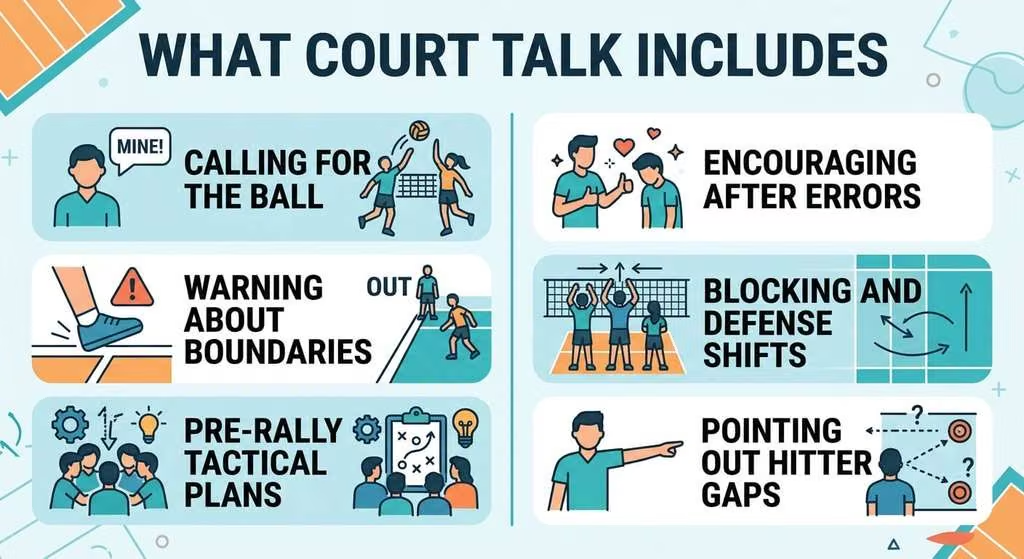
Effective court talk doesn’t need to be loud or complicated—it simply needs to be clear, quick, and intentional.
8 Reasons Why Communication is Important in Volleyball Matches
When examining why communication is important in volleyball, coaches consistently point to these eight fundamental game-changing factors:
1. It Prevents Dangerous On-Court Collisions
The primary reason why communication is important in volleyball defense is safety and clarity. When an opponent’s attack or serve lands between two defenders, both players naturally track the ball. Calling “Mine!” early and assertively claims ownership, eliminating hesitation and preventing painful on-court collisions.
2. It Helps Players Make Split-Second Decisions
Volleyball moves too fast for a single player to see everything.
- A hitter needs to know if the block is open or closed.
- A setter needs to know who is ready for a set.
- A defender needs to know if their seam is covered.
Communicating gives your teammates sensory information they cannot physically see in real time.
🏐 New to rotation positioning? Master your alignment with our guide on Volleyball Rotation for Beginners: 6 Easy Steps to Play with Confidence.
3. It Improves Overall Team Coordination
Before the server contacts the ball, successful teams talk through their plan. Another reason why communication is important in volleyball rallies is that pre-rally calls establish defensive positioning, blocking assignments, and serve-receive responsibilities so the team starts every point aligned.
4. It Perfects the Serve Receive
The serve receive is the foundation of offensive success. Miscommunication here leads to easy “ace” points for the opponent. Establishing clear seam coverage rules and calling the ball early keeps passing smooth and predictable.
5. It Optimizes Blocking and Back-Row Defense
Blockers and back-row defenders must act as a single unit. When blockers call out opposing hitter transitions and specify what angle they are taking, back-row defenders can adjust immediately to dig the ball.
6. It Builds On-Court Confidence and Energy
Energy is contagious in volleyball. Simple, supportive calls help keep team morale high throughout a grueling match:
- “You’ve got this!”
- “Next ball!”
- “Great hustle!”
- “Stay focused!”
7. It Accelerates Error Recovery
Unforced errors—a missed serve, a net touch, or a bad pass—are inevitable. Poor communication allows one mistake to snowball into a losing streak. Reassuring phrases like “Shake it off!” or “Reset, next point!” demonstrate why communication is important in volleyball teams building emotional resilience.
8. It Allows Teams to Adapt Strategy In-Game
When opponents change their tactical approach (such as repeatedly tipping short), observant players must speak up. Calling out tactical adjustments—like “Watch the short tip!”—allows the entire team to adjust defense dynamically.
Types of Volleyball Communication
To fully realize why communication is important in volleyball, teams must master three distinct modes of communication:
| Type of Communication | Examples / Signals | Purpose |
| Verbal Calls | “Mine!”, “Out!”, “Free!”, “Line!”, “Help!” | Quick, actionable tactical commands during live play. |
| Non-Verbal Signals | Hand signals behind the back, eye contact, body positioning | Setting offensive plays silently before the serve. |
| Positive Reinforcement | “Nice swing!”, “Great pass!”, “Keep pushing!” | Maintaining high team morale and psychological momentum. |
6 Proven Ways to Improve Communication on Your Team
Now that you know why communication is important in volleyball, here is how to practice it on the court:
- Establish Standard Team Calls: Keep verbal cues short and uniform so everyone reacts instantly without confusion.
- Call the Ball Early: Calling a ball while it is high in the air gives your teammates ample time to clear out or transition.
- Be Loud and Assertive: Gymnasiums are noisy. Speak with authority so your voice cuts through background crowd noise.
- Integrate Talk Into Every Drill: Practice communication during routine training drills—never wait until match day to start talking.
- Keep Feedback Constructive: Focus on solutions rather than placing blame when a mistake happens.
- Be an Active Listener: Communication is a two-way street. Always tune into your setter’s and libero’s calls.
Common Communication Mistakes to Avoid
- Staying Silent: Assuming a teammate will handle a ball without confirmation.
- Late Calling: Screaming “Mine!” milliseconds before the ball hits the floor.
- Vague Terminology: Shouting generic phrases instead of standardized calls.
- Over-instructing: Overwhelming teammates with long sentences during active rallies.
- Ignoring Teammate Calls: Overriding a clear call and causing confusion.
Final Thoughts
Understanding why communication is important in volleyball is the first step toward transforming your team’s overall performance. A single, decisive call of “Mine!”, a timely tactical warning, or a supportive word after a tough error can turn the momentum of an entire match.
Remember: Great volleyball players hit hard—but extraordinary volleyball teams communicate clearly.
Frequently Asked Questions (FAQ)
Why is communication important in volleyball?
Why communication is important in volleyball comes down to efficiency and teamwork: it prevents on-court collisions, clarifies individual player responsibilities, speeds up decision-making, and builds team cohesion during fast rallies.
What are the most common calls in volleyball?
The most common live-play calls are “Mine!” (taking the ball), “Out!” (letting a ball go out of bounds), “Free!” (preparing for an easy free ball attack), and “Help!” (asking a teammate to assist on an awkward pass).
How can a beginner improve their volleyball communication?
Beginners can improve by practicing loud calls during every training drill, learning standardized team signals, calling for the ball early, and actively encouraging teammates.
Does communication directly affect team performance?
Yes. Analytics and coaching studies clearly show why communication is important in volleyball success—communicative teams commit far fewer unforced errors, execute higher-percentage attacks, and recover faster from mistakes.



Finally found a spot that actually pays out on time without any drama. The game variety is top notch. Check out phjl18 if you want a reliable place to play.