
Volleyball is a team sport where every player has an important responsibility. Some players focus on attacking, others specialize in defense, and some organize the team’s offensive plays. Two of the most important positions are the setter and the libero.
But when comparing setter vs libero, which position is more important?
The setter is often considered the team’s playmaker because they organize attacks and decide which hitter receives the ball. On the other hand, the libero specializes in defensive skills, including passing, digging, and receiving serves. Both positions require excellent ball control, quick reactions, communication, and volleyball knowledge.
Although their responsibilities are different, both players have a major influence on how a team performs.
In this guide, we will explain the differences between a setter and a libero, their responsibilities, essential skills, advantages, and importance during a volleyball match. Whether you are a beginner learning volleyball positions or an experienced player choosing your role, this comparison will help you understand both positions.
1. What Is a Setter in Volleyball?

A setter is one of the most important offensive players on a volleyball team. Their primary responsibility is to deliver accurate sets to attackers so they can hit the ball over the net.
Think of the setter as the quarterback of a volleyball team. They organize offensive plays, make quick decisions, and help create scoring opportunities.
After the first pass, the setter usually takes the second contact and sends the ball toward an attacker.
Main Responsibilities of a Setter
A setter has several responsibilities during a volleyball match.
1. Setting Up Attacks
The setter delivers accurate balls to hitters, allowing them to attack effectively.
2. Making Quick Decisions
Setters must decide which attacker should receive the ball based on the quality of the pass, opponent positioning, and available attacking options.
3. Communicating With Teammates
They communicate with hitters and coordinate offensive plays before and during rallies.
4. Controlling the Game’s Tempo
A setter can change the speed and rhythm of attacks by using different set heights and locations.
5. Supporting Defense
Setters also participate in defensive plays, including blocking when positioned in the front row and covering teammates during attacks.
Essential Skills Every Setter Needs
A good setter should develop the following skills:
- Accurate hand positioning and ball control.
- Quick decision-making.
- Strong communication.
- Excellent footwork.
- Good court awareness.
- Consistent setting technique.
- Understanding of attacking strategies.
- Ability to remain calm under pressure.
A setter must also understand the strengths of teammates and know how to create opportunities for different hitters. Want to improve your setting technique? Read our complete guide on how to set a volleyball correctly to learn proper hand positioning, ball contact, and setting fundamentals
3. What Is a Libero in Volleyball?

A libero is a specialized defensive player who focuses on passing, digging, and receiving serves.
The libero is easy to recognize because they wear a jersey that contrasts with the rest of their team’s uniform.
Unlike most other players, the libero has specific restrictions under standard indoor volleyball rules. For example, the libero cannot complete an attack hit when the ball is entirely above the top of the net, cannot block or attempt to block, and cannot serve in some competitions depending on the applicable rules.
The libero generally replaces back-row players to strengthen the team’s defense without using a regular substitution.
Main Responsibilities of a Libero
1. Receiving Serves
One of the libero’s most important responsibilities is receiving opponents’ serves and delivering accurate passes to the setter.
2. Digging Attacks
The libero uses defensive techniques to keep hard-hit balls from touching the floor.
3. Improving Ball Control
A strong libero helps the team maintain control during difficult rallies.
4. Covering the Court
The libero moves quickly to cover open spaces and support teammates during defensive plays.
5. Communicating With Teammates
They call the ball, organize defensive coverage, and help teammates understand their responsibilities. You Should follow FIVB Official Volleyball Rules
Essential Skills Every Libero Needs
A successful libero should have:
- Excellent forearm passing.
- Quick reaction speed.
- Strong defensive positioning.
- Good anticipation.
- Consistent ball control.
- Excellent communication.
- Fast lateral movement.
- Confidence under pressure.
The libero does not need to be the tallest player on the team. Defensive technique, movement, anticipation, and consistency are particularly important. Accurate passing is essential for every libero. Check out our guide on improving your volleyball passing technique to develop better ball control and consistency
4. Setter vs. Libero: Key Differences

Although both positions require excellent ball control and communication, setters and liberos perform very different roles.
The setter focuses primarily on creating offensive opportunities, while the libero specializes in defensive performance.
Here is a comparison of their main responsibilities.
| Feature | Setter | Libero |
|---|---|---|
| Main role | Offensive playmaker | Defensive specialist |
| Primary responsibility | Setting up attacks | Passing and digging |
| Jersey | Regular team jersey | Contrasting jersey |
| Court position | Front row and back row | Back row only |
| Main skill | Accurate setting | Defensive ball control |
| Attacking | Can attack | Restricted from completing attacks above net height |
| Blocking | Can block | Cannot block or attempt to block |
| Serve | Can serve | Restricted under applicable competition rules |
| Communication | Organizes offensive plays | Organizes defensive coverage |
| Main objective | Create scoring opportunities | Prevent the ball from hitting the floor |
Setter vs. Libero: Which Skills Are Different?
Setter skills:
- Hand positioning and overhead setting.
- Reading the opponent’s defense.
- Choosing the right attacker.
- Controlling offensive tempo.
- Coordinating attacking combinations.
Libero skills:
- Forearm passing.
- Defensive digging.
- Reading attacking movements.
- Quick lateral movement.
- Receiving difficult serves.
Both positions require excellent concentration, but their technical responsibilities are different.
5. Setter vs. Libero: Which Position Is More Important?

This is the biggest question when comparing a setter vs libero.
The honest answer is that neither position is universally more important. Both contribute to different parts of the game, and a successful volleyball team needs strong offensive organization and reliable defense.
However, the importance of each position can become more noticeable in different match situations.
Why the Setter Is Important
The setter plays a central role in organizing the team’s offense.
Without accurate setting, attackers may struggle to execute effective attacks. Even talented hitters need good sets to perform consistently.
A skilled setter can:
- Create opportunities for multiple attackers.
- Make it difficult for opponents to predict attacks.
- Improve offensive coordination.
- Change the tempo of the game.
- Make better decisions during difficult rallies.
For example, when a team receives a good serve and makes an accurate first pass, the setter can choose between an outside hitter, middle blocker, or opposite hitter.
This variety makes the offense more difficult to defend.
Why the Libero Is Important
The libero plays a major role in keeping the ball in play and maintaining defensive stability.
Even when opponents perform powerful spikes or difficult serves, the libero helps the team control the ball and create another attacking opportunity.
A strong libero can:
- Improve serve-receive consistency.
- Prevent attacks from hitting the floor.
- Reduce defensive errors.
- Help teammates maintain confidence.
- Create better passing opportunities for the setter.
For example, when an opponent performs a powerful spike, the libero may dig the ball and send it toward the setter.
This defensive action can turn a difficult situation into an attacking opportunity.
Which Position Has a Bigger Impact on Winning?
It depends on the team’s strengths and weaknesses.
A team with powerful attackers but poor passing may struggle because the setter cannot consistently organize attacks.
Similarly, a team with excellent attacking ability but weak defense may lose rallies because it cannot control opponents’ serves and spikes.
The setter connects defense to offense, while the libero helps make that connection possible through reliable ball control.
Both positions are essential to a balanced volleyball team.
6. Can a Setter and Libero Play Together?

Yes! The setter and libero work together throughout a volleyball match.
Their responsibilities are closely connected because good defense creates better opportunities for the setter to organize attacks.
Here is how they typically work together during a rally:
- An opponent serves the ball.
- The libero or another back-row player receives the serve.
- The ball travels toward the setter.
- The setter delivers an accurate set to an attacker.
- The attacker attempts to score by hitting the ball over the net.
- If the opponent returns the attack, the libero helps defend the court.
This sequence demonstrates how defensive passing and offensive setting work together.
Example: A Successful Setter-Libero Combination
Imagine your team is receiving a difficult serve.
The libero moves into position and performs a controlled forearm pass toward the setter.
The setter then moves underneath the ball and delivers a high-quality set to the outside hitter.
The outside hitter completes the attack and scores a point.
In this situation, both players contribute to the successful play.
The libero provides the first-contact control, and the setter creates the attacking opportunity.
7. Which Position Is Better for Beginners?

If you are new to volleyball, you might wonder whether you should learn to play as a setter or libero.
Both positions are excellent choices, but the right one depends on your interests, natural abilities, and willingness to develop specific skills.
Choose Setter If You:
- Enjoy organizing team plays.
- Like making quick decisions.
- Have good hand-eye coordination.
- Enjoy working closely with attackers.
- Want to develop setting and offensive skills.
- Feel comfortable communicating with teammates.
Choose Libero If You:
- Enjoy defensive volleyball.
- Have quick reactions.
- Like receiving serves and digging attacks.
- Have good court awareness.
- Enjoy controlling difficult balls.
- Prefer playing in the back row.
Should Beginners Learn Both Positions?
Absolutely!
Even if you eventually specialize in one position, learning the basic techniques of both roles will make you a more complete volleyball player.
For example, setters benefit from understanding defensive passing, while liberos benefit from understanding how setters organize offensive plays.
Start by learning the fundamentals before deciding which position suits you best.
8. Training Drills to Improve as a Setter
If you want to become a better setter, focus on accuracy, hand positioning, footwork, and decision-making.
Here are four useful drills.
Drill 1: Wall Setting

Objective: Improve hand positioning and setting consistency.
How to practice:
- Stand a comfortable distance from a wall.
- Position your hands above your forehead.
- Push the ball upward using your fingers.
- Maintain a consistent rhythm.
- Repeat for several sets of controlled repetitions.
Focus on accuracy rather than speed.
Drill 2: Partner Setting

Objective: Develop ball control and coordination.
How to practice:
- Stand a few meters away from your partner.
- Set the ball toward your partner.
- Ask your partner to return the ball.
- Maintain a consistent ball height.
- Gradually increase the distance.
Drill 3: Footwork and Setting

Objective: Improve movement and positioning before setting.
How to practice:
- Begin in a ready position.
- Have a partner toss the ball to different locations.
- Move quickly underneath the ball.
- Establish a balanced setting position.
- Deliver an accurate set toward your target.
Drill 4: Target Setting
Objective: Improve setting accuracy.
How to practice:
- Choose a target area near the net.
- Practice setting the ball toward that location.
- Ask a partner to observe your accuracy.
- Adjust your footwork and hand positioning.
- Repeat from different starting positions.
9. Training Drills to Improve as a Libero
Liberos need excellent passing, defensive positioning, quick movement, and anticipation.
The following drills can help beginners develop these abilities.
Drill 1: Forearm Passing Against a Wall
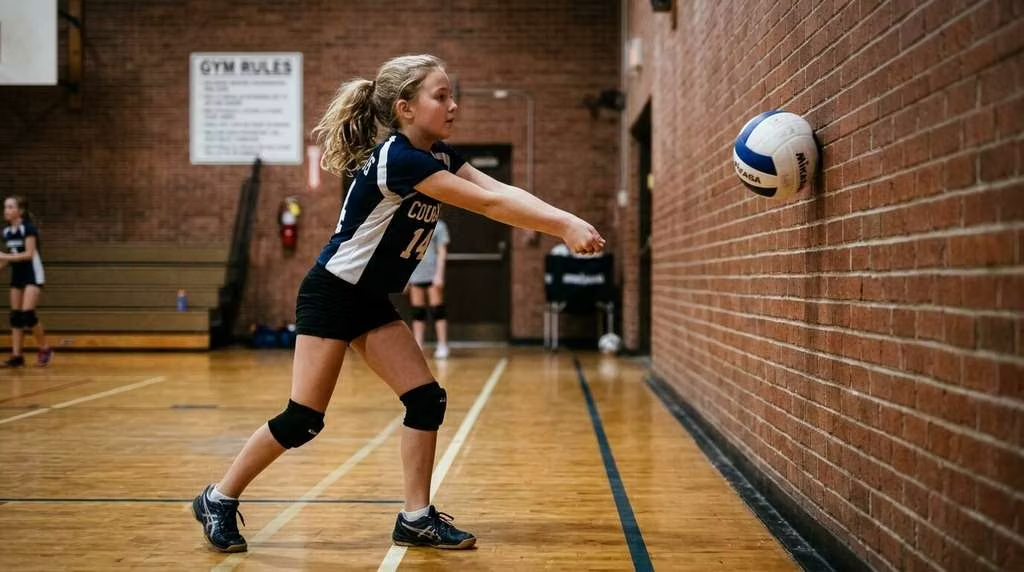
Objective: Develop consistent passing technique.
How to practice:
- Stand facing a wall.
- Toss the ball slightly upward.
- Pass it against the wall using your forearms.
- Maintain a stable passing platform.
- Control the ball as it returns.
Drill 2: Partner Passing
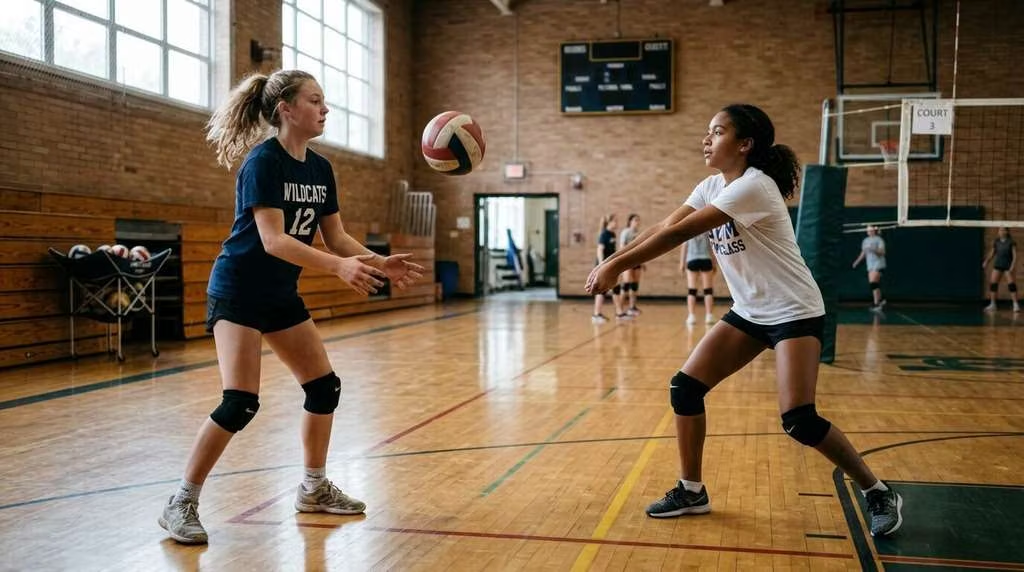
Objective: Improve serve-receive and passing accuracy.
How to practice:
- Stand several meters apart.
- Ask your partner to toss the ball toward you.
- Move into the correct position.
- Pass the ball toward your partner.
- Repeat with different ball directions.
Drill 3: Lateral Defensive Movement

Objective: Improve defensive footwork and movement.
How to practice:
- Place two cones several steps apart.
- Start in a low defensive position.
- Shuffle sideways toward the first cone.
- Move toward the second cone.
- Maintain your balance throughout the drill.
Drill 4: Defensive Digging Practice
Objective: Develop defensive reactions and ball control.
How to practice:
- Ask a partner or coach to toss balls toward you.
- Move into the correct defensive position.
- Keep your knees bent and body balanced.
- Use your forearms to dig the ball.
- Direct the ball toward a target area.
Remember to practice controlled movements before increasing the speed or difficulty.
10. Common Mistakes Setters and Liberos Should Avoid
Both positions require practice and discipline. However, beginners often make mistakes that affect their performance.
Common Setter Mistakes
- Inconsistent hand positioning: Incorrect finger placement can affect setting accuracy.
- Poor footwork: Not moving underneath the ball makes it difficult to deliver accurate sets.
- Making predictable decisions: Always setting to the same hitter makes the offense easier to defend.
- Ignoring communication: Not communicating with attackers can lead to timing problems.
- Rushing the set: Making decisions too quickly without reading the play can result in poor sets.
Common Libero Mistakes
- Poor defensive positioning: Standing too far from the expected attacking direction.
- Unstable passing platform: Bending the elbows or separating the hands while passing.
- Slow reactions: Waiting too long before moving toward the ball.
- Poor communication: Failing to call the ball during serve reception.
- Overusing arm movement: Swinging the arms excessively instead of controlling the ball with proper body positioning.
The best way to correct these mistakes is through consistent practice, feedback, and repetition.
11. How to Choose Between Setter and Libero
Choosing between these positions depends on your strengths, interests, and playing style.
Consider the following comparison:
| Your strength or preference | Recommended position |
|---|---|
| Excellent hand coordination | Setter |
| Quick decision-making | Setter |
| Enjoy organizing team attacks | Setter |
| Strong defensive instincts | Libero |
| Quick reaction speed | Libero |
| Excellent passing ability | Libero |
| Enjoy controlling offensive plays | Setter |
| Enjoy receiving serves and digging | Libero |
Remember that physical characteristics are not the only factors that determine which position is right for you.
Height, jumping ability, speed, coordination, technical skills, and experience all influence how players develop. A good coach can help you discover which role matches your abilities.
12. Can a Volleyball Player Switch Between Setter and Libero?
Players can learn the skills of both positions, but there are important differences between playing roles and official libero designation.
A regular player may develop setter and defensive skills and play different roles according to the team’s lineup.
However, a player designated as a libero must follow the specific libero rules during the match. The libero is a back-row defensive specialist and has restrictions on attacking, blocking, and serving under FIVB rules.
Under the FIVB indoor rules, the libero cannot serve. Some other competitions, including certain USA Volleyball rulesets, allow the libero to serve in one rotational position. Always check the rules of the competition you play in. FIVB+1
For beginners, learning both positions is a great way to understand the complete game before specializing.
13. Frequently Asked Questions (FAQs)
1. Is a setter more important than a libero?
Neither position is universally more important. The setter organizes offensive plays, while the libero strengthens the team’s defense. Both positions are necessary for a balanced volleyball team.
2. What is the main difference between a setter and a libero?
The main difference is their responsibility. A setter focuses on delivering accurate sets to attackers, while a libero specializes in defensive passing, digging, and serve reception.
3. Can a libero set the ball?
Yes. A libero can set the ball using their hands or forearms, but special restrictions apply to an overhand finger pass made from the front zone. Under FIVB rules, a teammate cannot complete an attack hit above the net from an overhand finger pass made by the libero while in the front zone.
4. Can a libero attack the ball?
A libero cannot complete an attack hit from anywhere on the court if the ball is entirely above the top of the net at the moment of contact.
5. Can a setter play in the back row?
Yes. A setter can play in both front-row and back-row positions. However, when playing as a back-row player, the setter must follow the applicable back-row attack restrictions.
6. Can a libero serve in volleyball?
Under standard FIVB indoor volleyball rules, a libero cannot serve. However, certain other competition rulesets allow a libero to serve in one rotational position.
7. Which position is easier for beginners?
Neither position is necessarily easier. Setting requires precise hand control and decision-making, while playing libero requires excellent passing, anticipation, and defensive movement.
8. Does a libero need to be tall?
No. A libero does not need to be particularly tall. Quick reactions, good defensive technique, anticipation, and ball control are important qualities for this position.
9. How many liberos can a volleyball team have?
Under FIVB rules, a team may designate up to two liberos, although only one libero can be on the court at a time. FIVB
10. What position should I learn first as a beginner?
Start by learning the fundamentals of passing, setting, serving, and defensive positioning. Once you understand these basic skills, you can decide which position best suits your playing style.
14. Final Verdict: Setter vs. Libero – Which Position Is More Important?
So, which position is more important: setter or libero?
The setter is essential for organizing attacks, creating scoring opportunities, and controlling offensive plays. The libero is equally valuable for receiving serves, defending powerful attacks, and maintaining consistent ball control.
Neither position can replace the other.
A talented setter needs accurate passes to organize effective attacks, while a strong libero needs a setter to turn defensive plays into offensive opportunities.
The best volleyball teams understand the importance of both positions and develop players who can work together effectively.
If you are a beginner, practice both offensive and defensive fundamentals before choosing your preferred position.
Remember: A great setter creates opportunities, a great libero keeps the ball alive, and a great team needs both!